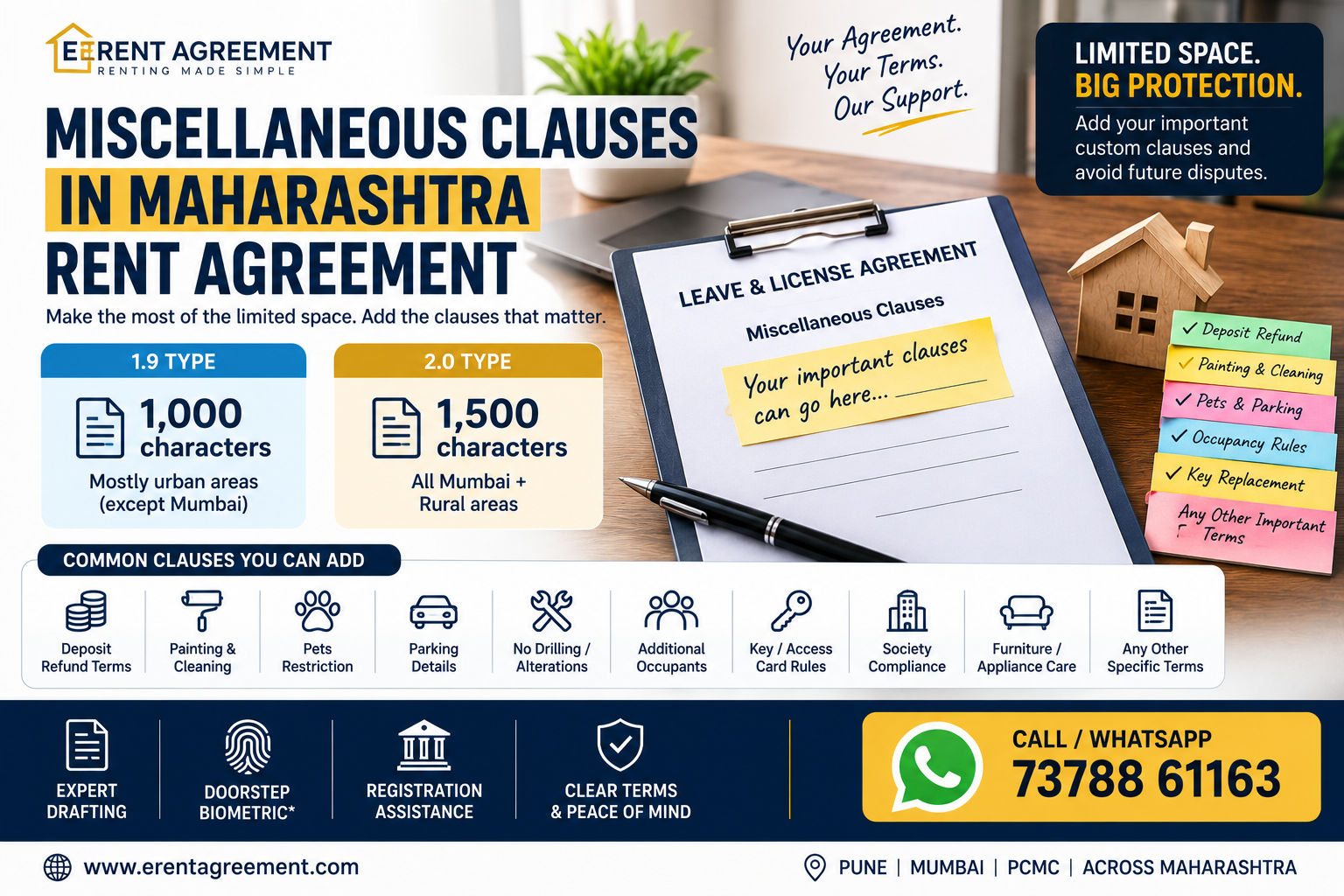
Miscellaneous Clauses in Maharashtra Rent Agreement: How to Use the Limited 1,000 / 1,500 Characters Wisely
Description: Maharashtra Leave & License Agreements provide limited space for custom miscellaneous clauses. Learn how to use the 1,000-character field in Leave & License 1.9 and 1,500-character field in 2.0, what clauses to prioritize, what not to repeat, and practical examples for owners and tenants.
What Is the “Miscellaneous” Clause in a Maharashtra Rent Agreement?
A Maharashtra Registered Leave & License Agreement already contains several standard clauses covering the basic structure of the rental relationship.
But every property and every Owner–Tenant arrangement is different.
You may want to add conditions relating to:
- Deposit refund
- Painting
- Cleaning
- Pets
- Parking
- Furniture
- Repairs
- Guests
- Society rules
- Rent payment date
- Key replacement
- Drilling
- Smoking
- Notice
- Employee occupancy
- Police verification
- Early exit
- Property condition
These requirements may not always be fully covered by the standard clauses.
That is where the Miscellaneous Clause becomes extremely useful.
Registered Maharashtra agreements themselves commonly contain a separate “Miscellaneous” section for additional terms. Examples of registered agreements available on Maharashtra government/public records also show parties using this section to record conditions beyond the standard format.
However, there is one major limitation:
The available space is limited.
So the objective should not be:
“How many clauses can we add?”
The better question is:
“Which clauses are most important for this particular property and rental arrangement?”
Character Limit: Leave & License 1.9 vs 2.0
In the current workflow used for Maharashtra Leave & License Agreements, the Miscellaneous field differs depending on the agreement version.
Leave & License 1.9
Approximately 1,000 characters available
This format is currently commonly encountered in many urban Maharashtra locations outside Mumbai.
Leave & License 2.0
Approximately 1,500 characters available
This is currently used for Mumbai and rural-area workflows handled through the 2.0 process.
Because portal configurations and jurisdictional workflows can change, the applicable version should always be checked while preparing the agreement.
The important point is:
You do not have unlimited drafting space.
A beautiful 2,500-word custom clause has no value if the government portal only allows a fraction of it.
Why the Miscellaneous Clause Is So Important
Consider two rental arrangements.
Property A
An unfurnished 1BHK with:
- No parking
- No pets
- No special restrictions
- No appliances
Property B
A premium furnished 3BHK with:
- ₹3 lakh security deposit
- 3 air-conditioners
- Refrigerator
- Washing machine
- Furniture
- Two parking spaces
- Society access cards
- Painting requirements
- Professional cleaning requirement
- Pet restrictions
Clearly, both properties should not use exactly the same custom clause.
The Miscellaneous section gives the parties an opportunity to record the conditions that matter specifically to their arrangement.
First Rule: Don't Waste the Space Repeating Standard Clauses
This is probably the most important drafting principle.
If a term is already adequately covered in the standard agreement, repeating the same thing in the Miscellaneous field wastes valuable characters.
For example, standard Maharashtra Leave & License agreements normally already contain clauses dealing with subjects such as:
- Agreement period
- Monthly compensation
- Security deposit
- Maintenance
- Electricity
- Permitted use
- Alterations
- Lock-in, where selected
- Cancellation
- Possession
- Furniture/appliances, where applicable
- Registration
Therefore, before adding a custom clause, ask:
Is this point already adequately covered elsewhere in the agreement?
If yes, use the limited Miscellaneous space for something more important.
Think of the Miscellaneous Field as Premium Space
Imagine you have only 1,000 characters.
Every sentence needs to earn its place.
Do not write:
“It has been mutually agreed and understood between the Licensor and Licensee that…”
again and again.
Instead write directly:
Licensee shall professionally clean the premises before handover.
Same meaning.
Far fewer characters.
Which Custom Clauses Should Be Given Priority?
There is no universal list because every rental arrangement is different.
However, the following are usually among the most useful areas to consider.
1. Security Deposit Refund Timeline
The standard agreement records the security deposit, but Owners and Tenants often want greater clarity about when it will be refunded.
For example:
Refundable deposit shall be returned within 7 days after vacant possession, subject to deduction of unpaid rent, electricity, maintenance, agreed damages and other outstanding dues.
This can prevent one of the most common move-out disputes:
“When exactly will I receive my deposit?”
2. Deposit Deductions
Simply writing “refundable deposit” may not answer what happens when there are outstanding charges.
Possible items may include:
- Unpaid rent
- Electricity
- Water
- Society dues
- Missing keys
- Missing furniture
- Damage beyond normal wear and tear
- Agreed cleaning expenses
Instead of listing every imaginable expense, prioritize the deductions that actually matter for that property.
3. Professional Cleaning
If the Owner expects the Tenant to return the property professionally cleaned, write it down.
Example:
Licensee shall return the premises in clean condition and arrange professional cleaning before handover.
This is much clearer than discussing cleaning charges only when the Tenant is leaving.
4. Painting / Wall Restoration
Painting disputes are common.
The Owner may say:
“The flat must be freshly painted.”
The Tenant may say:
“Normal wear and tear is expected.”
If painting responsibility is important, state the actual arrangement.
Example:
Damage caused by drilling, stickers, nails or unauthorized wall alterations shall be restored by Licensee before handover.
Notice how this is more specific than simply writing:
“Tenant shall paint the property.”
5. No Drilling / Structural Alterations
For newly furnished or premium properties, Owners may want:
No drilling, permanent fixtures or structural alterations without prior written consent of Licensor.
This is short and useful.
6. Pets
If pets are an important consideration, do not rely on assumptions.
Possible approaches:
Pets prohibited
Pets shall not be kept in the premises without prior written consent of Licensor.
Pets permitted subject to responsibility
One pet is permitted; Licensee shall be responsible for pet-related damage and society compliance.
Choose what you actually agreed.
7. Smoking
For some properties:
Smoking inside the premises is prohibited.
Short.
Clear.
No unnecessary drafting.
8. Parking
Parking disputes are extremely common because people casually say:
“Parking is included.”
But which parking?
If applicable, record:
- One car parking
- Two-wheeler parking
- Parking number
- Whether the space is exclusive
- Whether society allocation applies
Example:
One car parking space allotted by the society is included for Licensee's use during the agreement tenure.
9. Keys and Access Cards
This is especially useful in gated societies.
Example:
2 main-door keys, 2 access cards and 1 parking remote are handed over and shall be returned on vacating. Replacement cost for lost items shall be borne by Licensee.
A small clause can eliminate a surprising amount of confusion.
10. Furniture / Appliance Damage
The standard agreement may contain an inventory section, but the parties may still want to clarify responsibility.
Example:
Furniture/appliances shall be returned in existing condition subject to normal wear and tear; damage due to misuse shall be repaired by Licensee.
11. Final Electricity Bill
A useful deposit-refund condition:
Final electricity and other usage-based dues shall be cleared before security-deposit settlement.
Simple and practical.
12. Society Rules
Instead of copying the society's entire rulebook into the agreement:
Licensee shall comply with applicable society rules and move-in/move-out procedures.
This can save significant space.
13. Police / Occupant Information
Where applicable to the property and jurisdiction:
Licensee shall cooperate in providing documents required for applicable tenant-information or police formalities.
Police requirements can vary by jurisdiction, so avoid drafting overly broad statements that may not match the current local process.
14. Additional Occupants
If the property is being given to specific occupants:
Only persons declared in the agreement/application shall ordinarily occupy the premises; additional permanent occupants require prior consent.
This is particularly useful for shared accommodation.
15. Subletting
If this is important:
Licensee shall not sublet, assign or transfer possession of the premises to any third party.
Keep it concise.
16. Guest / Overnight Stay Conditions
Some Owners have specific requirements around long-term guests.
Instead of writing overly intrusive or vague restrictions, define the genuine commercial concern.
For example:
Long-term additional occupancy beyond declared occupants requires prior written approval of Licensor.
This is usually clearer than trying to regulate every visitor.
17. Property Photographs at Possession
A very useful modern clause:
Parties acknowledge possession-condition photographs/video recorded at handover as reference for condition of premises and listed contents.
This can help significantly during deposit settlement.
18. Inventory
Rather than using 300 characters to list twenty appliances inside Miscellaneous, use the designated furniture/inventory functionality where available.
Use Miscellaneous only to explain special responsibility, for example:
Inventory listed in the agreement shall be verified at possession and returned subject to normal wear and tear.
19. Rent Payment Date
If the specific payment window matters:
Monthly compensation shall be paid on or before the 5th day of each month.
But first check whether the payment requirement is already adequately recorded in the standard agreement.
Do not waste Miscellaneous characters unnecessarily.
20. Rent Increase
If varying rent or escalation is already captured elsewhere in the agreement, don't repeat it.
If a special arrangement is not otherwise captured, ensure it is drafted precisely.
Instead of:
“Rent shall increase later.”
Use:
Monthly compensation shall increase by 5% after completion of 12 months.
Dates or slabs are even better where space permits.
21. Notice Period Clarification
The standard Cancellation Clause may already contain one-month written-notice language.
If the parties are also inserting a separately negotiated notice provision, it should be drafted carefully so the two provisions do not create confusion.
For example:
After completion of lock-in, either party may terminate the arrangement by 60 days' prior written notice, subject to the Cancellation Clause.
Notice and cancellation should be reviewed together.
22. Lock-In Consequences
Simply saying:
“11 months lock-in”
may not answer what happens if someone leaves early.
If the standard lock-in configuration does not adequately capture the parties' arrangement, the Miscellaneous clause can clarify consequences, provided the wording is properly reviewed.
Because lock-in clauses can have meaningful financial consequences, avoid writing overly aggressive or ambiguous language merely to save characters.
23. Renewal Deposit Carry-Forward
This is highly useful for renewal agreements.
Example:
Existing refundable deposit of ₹1,00,000 paid under the previous agreement is carried forward; no fresh deposit is payable.
A Maharashtra government-hosted registered-agreement example itself shows the Miscellaneous section being used to record a previous deposit being carried forward into a renewal.
24. Repair Responsibility
If the parties have a particular arrangement:
Minor day-to-day repairs shall be borne by Licensee; structural repairs not caused by misuse shall be borne by Licensor.
The actual allocation should reflect what both parties have agreed and applicable law.
25. Appliance Servicing
For furnished properties:
Routine AC servicing shall be arranged by Licensee; major failure not caused by misuse shall be informed to Licensor promptly.
Use this only if appliances are actually relevant.
What Should NOT Be Put Into Miscellaneous Just Because Space Is Available?
Limited space should not encourage random clauses.
Avoid adding conditions merely because:
“We still have 300 characters left.”
Every condition should have a practical reason.
Also avoid:
Contradicting Standard Clauses
Example:
Standard agreement says one thing.
Miscellaneous says the opposite.
This creates ambiguity rather than protection.
Impossible Obligations
A clause that cannot realistically be complied with is not useful merely because it fits the field.
Vague Language
“Tenant will maintain everything.”
What does “everything” mean?
Unnecessary Repetition
If maintenance is already clearly covered, don't type the same maintenance clause again.
Extremely Long Legal Language
The Miscellaneous field is not the place to copy four paragraphs from a 20-page commercial lease.
The 1,000-Character Strategy for Leave & License 1.9
When you have approximately 1,000 characters, prioritize ruthlessly.
A practical priority order could be:
Priority 1 — Money
Deposit refund and deductions.
Priority 2 — Exit
Notice / handover where additional clarification is genuinely needed.
Priority 3 — Property Protection
Cleaning, drilling, damage.
Priority 4 — Property-Specific Issues
Parking, pets, furniture or keys.
Priority 5 — Administrative Requirements
Society / occupancy details.
Not every property needs all five categories.
Example: Compact 1.9 Miscellaneous Clause
For a typical furnished apartment, a concise custom clause could read:
On vacating, Licensee shall return the premises clean and in existing condition subject to normal wear and tear. Damage due to misuse, drilling or unauthorized alterations shall be repaired at Licensee's cost. Final electricity and agreed dues shall be cleared before deposit settlement. Refundable deposit shall be returned within 7 days of vacant possession after permissible deductions. All keys/access cards/parking remotes handed over shall be returned; replacement cost of lost items shall be borne by Licensee. Licensee shall comply with society rules and shall not sublet or permit permanent additional occupants without prior consent of Licensor.
This uses the available space for practical issues rather than duplicating the entire standard agreement.
The wording should still be tailored to the actual property.
The 1,500-Character Strategy for Leave & License 2.0
An additional 500 characters can make a substantial difference.
With approximately 1,500 characters, you may be able to cover:
- Deposit refund
- Deductions
- Cleaning
- Property damage
- Keys/access cards
- Parking
- Pets
- Occupancy
- Society compliance
- Handover photographs
- Repair allocation
But the same rule applies:
Do not fill 1,500 characters simply because 1,500 are available.
Shorter and clearer is better than longer and contradictory.
Example: Detailed 2.0 Miscellaneous Clause
For a premium furnished property, the clause might be structured like this:
Licensee shall maintain the premises and listed furniture/appliances carefully and return them in existing condition subject to normal wear and tear. Damage due to misuse, drilling, stickers, unauthorized alterations or negligence shall be restored at Licensee's cost. Licensee shall arrange professional cleaning before handover and clear electricity, utility and other agreed dues. Refundable security deposit shall be returned within 7 days of vacant possession after deduction of outstanding dues and agreed damage/repair costs. All keys, access cards and parking remotes handed over shall be returned; replacement charges for lost items shall be borne by Licensee. One allotted car parking is included. Licensee shall comply with applicable society rules, shall not sublet the premises, and shall not add permanent occupants without prior consent. Possession-condition photographs/video taken at handover may be referred to while assessing property condition at vacating.
Again, this is an illustrative clause, not a universal clause for every property.
Don't Use the Same 1,500 Characters for Every Customer
This is particularly important.
A 3BHK furnished apartment in Mumbai may require emphasis on:
- Furniture
- Parking
- Access cards
- Deposit
- Cleaning
A 1RK in Pune may need only:
- Deposit refund
- Electricity
- No subletting
A commercial property may require completely different wording.
A company-rented apartment may need:
- Authorized employee occupancy
- Employee replacement
- Company responsibility
- Property-use restriction
A shared flat may need:
- Tenant replacement
- Joint deposit
- Additional occupancy
The best miscellaneous clause is the one that addresses the actual risks and expectations of that agreement.
Example: Owner With a Pet Restriction
Instead of spending characters on five generic clauses that don't matter, the Owner may prioritize:
Pets shall not be kept without prior written consent of Licensor. Licensee shall comply with society rules, shall not drill or structurally alter the premises, and shall return the property professionally cleaned. Refundable deposit shall be settled within 7 days of vacant possession after deduction of outstanding utilities and agreed damage costs.
Specific beats generic.
Example: Tenant Concerned About Deposit Refund
A Tenant may be more concerned about:
- Refund timing
- What can be deducted
- Normal wear and tear
- Final inspection
A useful clause may therefore prioritize:
Parties shall conduct a joint inspection at handover. Refundable deposit shall be returned within 7 days after vacant possession after adjustment of unpaid rent, actual utility dues and agreed damage beyond normal wear and tear. Any deduction shall be communicated with details to Licensee.
This can be more useful than adding a generic “no pets” clause to a Tenant who does not own a pet.
Example: Furnished Premium Property
Priorities may be:
- Inventory
- Damage
- Cleaning
- Keys/access cards
- Deposit deductions
- Property-condition record
Example: Shared Accommodation
Priorities may be:
- Named occupants
- Replacement of roommate
- No unauthorized subletting
- Total rent responsibility
- Deposit settlement
- Notice
Example: Company Accommodation
Priorities may include:
- Authorized employee occupancy
- Employee replacement
- Residential-use restriction
- Company responsibility for occupants
- Deposit
- Handover
A Better Way to Draft: Rank Clauses Before Typing
Before preparing Miscellaneous, create three groups.
MUST HAVE
If omitted, this could realistically cause a dispute.
Examples:
- Deposit-refund timeline
- Pet restriction for a pet-sensitive property
- Employee replacement
- Parking rights
GOOD TO HAVE
Useful but not essential.
Examples:
- Cleaning
- Meter readings
- Key count
ALREADY COVERED
Do not repeat.
Examples may include any items already clearly dealt with by the standard agreement.
Then draft MUST HAVE first.
If characters remain, add GOOD TO HAVE.
Character-Saving Drafting Techniques
Avoid Introductions
Don't write:
“It is hereby mutually decided and mutually agreed between both the parties that…”
Write:
Both parties agree that…
Or simply state the obligation directly.
Avoid Repeating Party Names
Instead of:
“The said Licensee Mr. X shall…”
use:
Licensee shall…
Combine Related Conditions
Instead of:
Electricity must be paid.
Water must be paid.
Internet must be paid.
Use:
Licensee shall clear applicable electricity, utility and internet dues before handover.
Use Defined Terms
Use:
Licensor
Licensee
Premises
Deposit
rather than repeatedly writing full names and property addresses.
Avoid Decorative Language
Contract language should be clear, not dramatic.
A short clause that everyone understands is more useful than a complicated sentence designed to sound “legal.”
Never Sacrifice Clarity Just to Fit More Clauses
There is a limit to compression.
This is poor drafting:
Lsee liable all dmg/elec/maint/key/pet/paint etc dep deduct owner decide.
It may save characters, but it creates new questions.
A clause should still be readable by:
- Owner
- Tenant
- Registration professional
- Advocate
- Authority
- Court/tribunal, if a dispute eventually arises
Use complete, understandable sentences.
Character Limit Makes Draft Review More Important
When several conditions are compressed into one Miscellaneous paragraph, review becomes essential.
Check:
Does it contradict the standard agreement?
Does it contradict the lock-in clause?
Does it contradict the cancellation clause?
Is the notice period consistent?
Is deposit refund wording clear?
Are repair obligations practical?
Is the clause understandable?
Is anything important missing?
Standard Clause + Miscellaneous Clause Must Be Read Together
The Miscellaneous Clause does not exist in isolation.
For example:
Standard Cancellation Clause
One month's written notice.
Miscellaneous Clause
Two months' notice.
Now the agreement potentially contains different notice periods.
Without explaining when each applies, the custom clause could create the exact uncertainty it was meant to eliminate.
That is why adding more clauses does not always mean getting more protection.
Consistency is more important than quantity.
Should You Copy Miscellaneous Clauses From an Old Agreement?
Not blindly.
An old agreement may have been prepared for:
- Another property
- Another Tenant
- Another Owner
- Another deposit
- Another notice period
- Another portal version
- Different furniture
- Different parking
- Different circumstances
Use old agreements as reference only.
Ask again:
What actually matters in this agreement?
Why eRent Agreement Reviews Custom Requirements Before Registration
At erentagreement.com, we recommend identifying the important custom requirements before finalizing the draft.
The process should be:
1. Understand the arrangement
2. Check what standard clauses already cover
3. Identify the missing requirements
4. Prioritize them
5. Draft them concisely within the available portal limit
6. Review the entire agreement together
7. Approve before biometric
This is much better than copying ten random clauses and discovering that the most important one did not fit.
Our Simple Rule for Miscellaneous Clauses
Limited Characters. Unlimited Possibilities. Prioritize What Matters.
For Leave & License 1.9, approximately 1,000 characters means every sentence needs to be purposeful.
For Leave & License 2.0, approximately 1,500 characters provides more room—but it is still limited space.
Therefore:
Don't add every possible clause.
Add the clauses that matter to your property, your money and your rental arrangement.
Frequently Asked Questions
What is the Miscellaneous Clause in a Maharashtra Rent Agreement?
It is the section used to record additional agreed conditions that are not adequately dealt with by the standard agreement clauses. Registered Maharashtra agreements commonly show a separate Miscellaneous section.
How much custom text can be added?
In the current workflow used for the agreements we process, Leave & License 1.9 provides around 1,000 characters, while Leave & License 2.0 provides around 1,500 characters for miscellaneous/custom wording. Portal limits and workflows should be checked at the time of preparation.
Where is Leave & License 1.9 generally used?
In the current operational workflow, 1.9 is commonly used for many urban Maharashtra locations outside Mumbai.
Where is Leave & License 2.0 generally used?
The current 2.0 workflow is used across Mumbai and applicable rural-area registrations.
Should I enter as many clauses as possible?
No. The goal is to include the most important missing terms, not the highest possible number of sentences.
Should I repeat the security deposit amount?
If the amount is already properly captured in the standard agreement, use Miscellaneous to explain a useful additional condition such as the refund timeline or agreed deductions rather than simply repeating the figure.
Can I add a 60-day notice period?
Custom notice wording can be added where appropriate, but it must be reviewed alongside the standard Cancellation Clause and lock-in provisions to avoid conflicting terms.
Can I mention painting and cleaning?
Yes, if those are genuinely agreed conditions and are important to the parties.
Can I add pet restrictions?
Yes, subject to the parties' agreement and applicable rules.
Can I add furniture conditions?
Yes, although the designated furniture/inventory section should be used where available. Miscellaneous space is better used for responsibilities relating to damage, maintenance or return condition.
Can custom clauses override the law?
A private agreement cannot simply make an otherwise unlawful condition lawful. Clauses should be consistent with applicable law, the rest of the agreement and the parties' genuine arrangement.
How eRent Agreement Can Help
Custom clauses are valuable only when they are drafted clearly and used strategically.
With erentagreement.com, Owners and Tenants can get assistance with:
📝 Draft Review Before Registration
⚙️ Custom Miscellaneous Clause Configuration
🔒 Lock-in & Notice Period Terms
💰 Security Deposit & Refund Conditions
🛠️ Repairs, Cleaning & Maintenance Clauses
🪑 Furniture & Inventory Conditions
🐾 Pet / Occupancy Requirements
🚗 Parking Clauses
🏠 Registered Leave & License Agreement Assistance
🖐️ Doorstep Biometric Coordination*
📧 Digital Agreement Delivery
🎁 FREE Virtual Consultation with a Practising Advocate worth ₹599* after successful agreement completion and during the agreement tenure, subject to applicable terms.
📞 Call / WhatsApp: 7378861163
🌐 www.erentagreement.com
Final Takeaway
The Miscellaneous section may look like a small box in the Rent Agreement application.
But it can contain some of the most practically important conditions in the entire rental arrangement.
The problem is that space is limited.
Leave & License 1.9 ≈ 1,000 characters
Leave & License 2.0 ≈ 1,500 characters
So don't waste that space copying standard clauses.
Instead ask:
What could realistically cause a dispute in THIS property?
Is it:
Deposit?
Painting?
Cleaning?
Pets?
Parking?
Keys?
Furniture?
Roommate replacement?
Notice?
Employee occupancy?
Then use the available space for those requirements.
Don't try to fit every clause. Fit the right clauses.
Standard clauses provide the framework. Miscellaneous clauses personalize the agreement.
And with only 1,000 or 1,500 characters available, good drafting is about prioritization—not quantity.
Disclaimer: This article provides general educational information and is not legal advice. The available portal fields, limits, version applicability and registration workflow can change. Custom clauses should reflect the parties' actual arrangement and should be reviewed for consistency with the standard agreement and applicable law.
Primary Keyword: Miscellaneous Clauses in Maharashtra Rent Agreement
Secondary Keywords: custom clauses rent agreement Maharashtra, miscellaneous clause Leave and License, rent agreement 1.9 clauses, Leave and License 2.0 clauses, custom rent agreement clauses Pune, Mumbai rent agreement clauses, 1500 character rent agreement clause

 +91-7378861163
  info@erentagreement.com
  8:00AM - 9:00PM