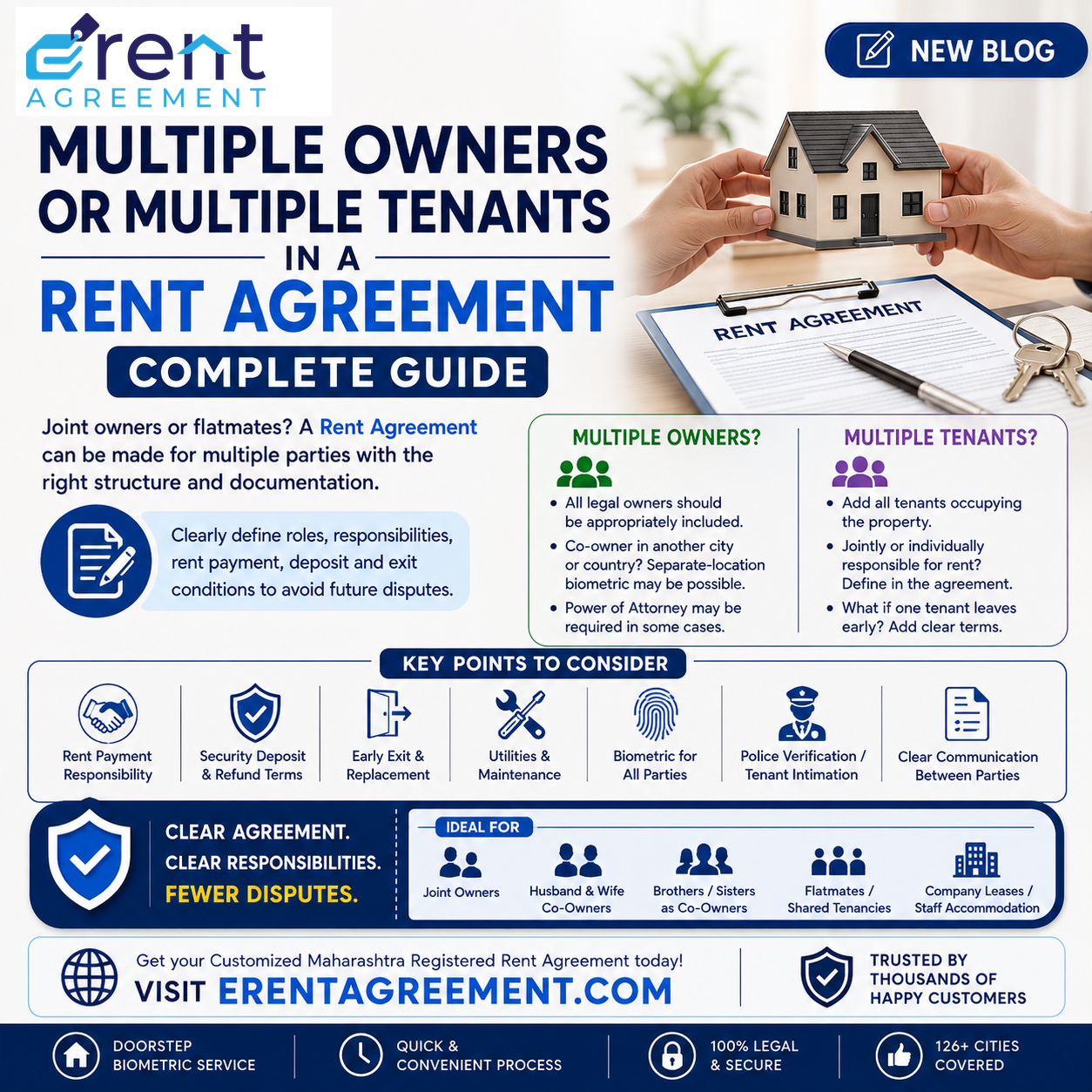
Multiple Owners or Multiple Tenants in a Maharashtra Rent Agreement: Complete Guide Last Updated:
September 2026
A Rent Agreement is not always between just one owner and one tenant.
Many properties have:
- Two or more joint owners
- Husband and wife as co-owners
- Brothers or sisters owning property together
- Parents and children as joint owners
- Two working professionals renting together
- Three or more flatmates
- Company employees sharing a rented property
This creates an important question:
Can multiple owners or multiple tenants be added to a Maharashtra Registered Rent Agreement?
In many cases, yes.
The agreement should correctly identify the actual parties involved, and the applicable registration, document and biometric requirements should be followed for each relevant party.
At ERENTAGREEMENT, we assist owners and tenants with Maharashtra Registered Rent Agreements involving single as well as multiple parties, subject to applicable government procedures.
What Is a Multiple-Party Rent Agreement?
A multiple-party Rent Agreement simply means that more than one person is participating on either side of the agreement.
For example:
Two Owners + One Tenant
Owner 1: Mr. A
Owner 2: Mrs. B
Tenant: Mr. C
Or:
One Owner + Two Tenants
Owner: Mr. A
Tenant 1: Mr. B
Tenant 2: Ms. C
Or:
Two Owners + Three Tenants
All relevant parties can be recorded according to the actual ownership and tenancy arrangement.
Should All Property Owners Be Mentioned in the Rent Agreement?
The agreement should correctly reflect the legal and practical arrangement relating to the property.
If the property is jointly owned, the ownership documents should be reviewed to understand whose names appear as owners.
Depending on the circumstances, all relevant owners may need to be appropriately represented in the agreement or the transaction may require valid authorization from one owner to act for another.
Do not simply omit a co-owner because it makes the process easier.
Accurate ownership information helps avoid future disputes.
Example: Husband and Wife Are Joint Owners
Suppose a flat in Pune is owned jointly by:
Mr. Rahul Sharma
and
Mrs. Priya Sharma
and the property is being rented to one tenant.
The agreement should be prepared based on the actual ownership arrangement and applicable registration requirements.
Where both owners are required to participate, their:
- Names
- Identity details
- PAN/Aadhaar details
- Required declarations
- Biometric authentication
may need to be completed as applicable.
What If One Co-Owner Is Outside the City?
This is common.
For example:
Property: Pune
Owner 1: Pune
Owner 2: Mumbai
Tenant: Pune
The fact that the owners are in different cities does not automatically mean the agreement cannot be completed.
Depending on the applicable registration process and service availability, separate-location biometric coordination may be possible.
ERENTAGREEMENT can check the available process based on the location of each party.
What If One Owner Is Outside India?
Consider:
Property: Mumbai
Owner 1: Mumbai
Owner 2: USA
Tenant: Mumbai
Such a case requires more careful coordination.
Depending on the circumstances, documentation, authorization and current registration process, an overseas owner's participation may require a different arrangement.
Customers should therefore share the exact ownership structure before the agreement draft is prepared.
Can a Power of Attorney Be Used?
Where an owner cannot personally participate, a valid Power of Attorney (POA) may sometimes be relevant depending on the nature of the authority and the applicable registration requirements.
However, having a POA does not automatically mean every type of authority is sufficient for every transaction.
The document should be reviewed to determine whether the attorney is legally authorized to execute or participate in the relevant rent agreement transaction.
If a POA is involved, inform the service provider before preparing the agreement.
Can Multiple Tenants Be Added to One Rent Agreement?
Yes, where multiple people will occupy the property as tenants/licensees, they can be appropriately included in the agreement according to the actual arrangement.
For example:
A 3BHK flat in Kharadi may be rented by three working professionals:
Tenant 1: Amit
Tenant 2: Karan
Tenant 3: Rohit
If all three are intended to be parties to the agreement, their details should be correctly included.
Why Is It Important to Mention All Tenants?
Suppose three people are living in the property but only one tenant is mentioned in the agreement.
Later, issues can arise regarding:
- Who is legally occupying the property
- Rent responsibility
- Security deposit
- Police/tenant intimation
- Society records
- Notice period
- Damage responsibility
- Vacating the property
If someone is intended to be a formal tenant/licensee, it is better to document the arrangement properly.
Multiple Tenants and Rent Responsibility
One important clause should address whether the tenants are responsible:
Individually
Each tenant is responsible only for an agreed share.
or
Jointly
All tenants are jointly responsible for the rent and other obligations.
For example:
Monthly Rent: ₹45,000
Three tenants may internally contribute:
₹15,000 + ₹15,000 + ₹15,000.
But the owner may want the agreement to provide that the tenants are collectively responsible for the full ₹45,000.
This should be clarified in the agreement.
What About the Security Deposit?
Security deposit arrangements should also be clearly documented.
For example:
Total Deposit: ₹90,000
The tenants may contribute:
Tenant 1 – ₹30,000
Tenant 2 – ₹30,000
Tenant 3 – ₹30,000
However, from the owner's perspective, the agreement may simply record one total security deposit of ₹90,000.
The parties should also decide:
- Who will receive the refund?
- Will the owner refund each tenant separately?
- Will the full deposit be refunded to one nominated tenant?
- What happens if one tenant leaves early?
These questions should be discussed before registration.
What If One Tenant Wants to Leave Early?
This is where multiple-tenant agreements often become complicated.
Suppose three tenants sign an 11-month agreement.
After four months, Tenant 2 wants to move out.
Important questions arise:
- Does the whole agreement terminate?
- Can Tenant 2 simply leave?
- Is a replacement tenant allowed?
- Does the owner need to approve the replacement?
- Will a fresh agreement be required?
- How will the deposit be adjusted?
The original agreement should ideally contain a clause dealing with this situation.
Can a Tenant Be Replaced Midway?
Do not simply replace one person's name informally.
If a registered agreement names specific tenants and one tenant changes, the legal/documentation implications should be checked.
Depending on the situation, a fresh agreement or other appropriate documentation may be required.
The owner should avoid allowing a new occupant to replace a named tenant without updating the records appropriately.
Multiple Owners and Rent Payment
If the property has two or more owners, tenants should know:
- To whom rent should be paid
- Which bank account should be used
- Whether one owner is authorized to collect rent
- Who will issue acknowledgment, if required
This should be made clear.
For example:
“Monthly rent shall be paid to the bank account designated by Owner 1 on behalf of the joint owners.”
Clarity prevents future disputes between owners and tenants.
Multiple Owners and Security Deposit Refund
The same issue applies to the security deposit.
If the tenant paid the complete security deposit into one co-owner's bank account, the agreement should still clearly state the total deposit and the responsibility to refund it at the end of the tenancy.
The tenant should not later be placed in a situation where one co-owner says:
“I did not receive the deposit, ask the other owner.”
The agreement should clearly allocate responsibility.
What Documents May Be Required for Multiple Owners?
Depending on the transaction, documents may include:
For Each Relevant Owner
- Aadhaar
- PAN
- Ownership-related documentation
- Contact information
Property Documents
Examples may include:
- Index II
- Electricity bill
- Other acceptable property documents
If Authorization Is Involved
Additional documents such as:
- Power of Attorney
- Authorization
- Company documents, if applicable
The exact document requirement should be checked for each case.
What Documents May Be Required for Multiple Tenants?
For each tenant/licensee, commonly required information may include:
- Aadhaar
- PAN
- Current/permanent address
- Mobile number
- Other applicable details
Witness details are also required according to the registration process.
Is Biometric Required for Every Owner and Tenant?
Biometric participation depends on the applicable registration process and the role of each party.
Where multiple owners or tenants are parties to the agreement, each relevant participant may need to complete the required authentication formalities.
This is why it is important to tell your Rent Agreement provider about all parties before booking biometric appointments.
What If All Parties Are in Different Locations?
Consider this situation:
Property: Pune
Owner 1: Pune
Owner 2: Mumbai
Tenant 1: Pune
Tenant 2: Bangalore
This is more complicated than a standard one-owner/one-tenant case, but separate-location coordination may still be possible depending on:
- Number of parties
- Location of each party
- Applicable registration procedure
- Biometric service availability
Additional visit/service charges may apply.
Obtain the complete quotation before scheduling.
Fingerprint Not Matching for One Party?
With multiple parties, there is also a greater chance that one participant may experience fingerprint authentication difficulty.
This is particularly possible with:
- Senior citizens
- People with faint fingerprints
- People whose fingerprints frequently fail during Aadhaar authentication
For applicable cases, iris authentication support may be available subject to the current government authentication process and device availability.
If any party already knows they have biometric issues, inform the ERENTAGREEMENT team in advance.
Multiple Tenants and Police Verification / Tenant Intimation
This is another important issue.
If multiple tenants are occupying the property, do not automatically assume that submitting information for only one tenant is sufficient.
Applicable police/tenant-intimation requirements should be checked for all relevant occupants.
Maintain accurate records of:
- Tenant names
- Identity details
- Agreement dates
- Property address
- Contact information
This is particularly important for shared accommodation.
What If a Company Is the Tenant?
Some rental properties are taken by companies for:
- Employees
- Directors
- Executives
- Guest houses
- Staff accommodation
In such cases, additional company documents may be required.
These can include documents relating to:
- Company identity
- Authorized signatory
- Board authorization
- Signatory authority
- Occupant details
Corporate tenancy should therefore be discussed before preparing the draft.
What If the Property Is Owned by a Company?
Similarly, where the property owner is a company or legal entity, the agreement may require appropriate corporate authorization and signatory documentation.
Do not treat it exactly like an individual-owner agreement.
Clauses to Consider for Multiple Tenants
A multiple-tenant agreement should ideally address:
Rent Responsibility
Who is responsible for the total monthly rent?
Deposit
How will the deposit be refunded?
Early Exit
What happens if one tenant leaves?
Replacement Tenant
Can someone else replace a tenant?
Damage
Who is responsible for tenant-caused damage?
Utilities
How are electricity, gas and other charges allocated?
Notice
Can one tenant independently give notice?
Possession
When is the property considered fully handed back?
These issues become much easier when addressed before registration.
Clauses to Consider for Multiple Owners
Where there are joint owners, consider addressing:
- Who receives rent
- Who receives deposit
- Who communicates with tenant
- Who coordinates repairs
- Who refunds the deposit
- Whether one owner is authorized to act for others
- How notices should be delivered
The tenant should have a clear point of contact.
Common Mistakes to Avoid
1. Mentioning Only One Owner When the Property Is Jointly Owned
Check the ownership structure first.
2. Allowing Multiple Occupants but Mentioning Only One Tenant Without Considering the Consequences
Document the actual arrangement correctly.
3. Not Clarifying Deposit Refund
Particularly important with multiple tenants.
4. Assuming One Biometric Appointment Covers Everyone
Authentication requirements should be checked for every relevant party.
5. Replacing a Tenant Informally
Do not simply change occupants without considering the registered agreement.
6. Ignoring Police/Tenant Intimation for Additional Tenants
Keep occupancy records accurate.
7. Not Discussing Early Exit
Flat-sharing arrangements often change during the tenure.
Example: Two Owners and Two Tenants
Consider:
Property: Baner, Pune
Owners:
Mr. A
Mrs. B
Tenants:
Mr. C
Ms. D
The agreement should correctly record:
- Both relevant owners
- Both tenants
- Total rent
- Total deposit
- Tenure
- Notice period
- Rent payment mechanism
- Deposit refund mechanism
- Repair responsibilities
- Applicable biometric participation
- Witness information
If one owner is in Mumbai and the others are in Pune, biometric coordination can be planned accordingly, subject to service availability.
Example: Three Flatmates
Consider:
Property: Kharadi, Pune
Monthly Rent: ₹36,000
Deposit: ₹90,000
Tenants:
Tenant A
Tenant B
Tenant C
Rather than depending only on informal WhatsApp discussions between the flatmates, the agreement should clarify the formal responsibilities of the tenants toward the owner.
This becomes especially important if one flatmate later leaves.
Can the Rent Agreement Be Customized?
Yes.
The clauses can reflect the mutually agreed terms between the parties, subject to applicable law and registration requirements.
For multiple-party agreements, customization is particularly useful.
At ERENTAGREEMENT, customers can discuss their requirements before the draft is finalized.
Frequently Asked Questions
Can two owners be added to a Rent Agreement?
Yes, joint ownership can be appropriately reflected in the agreement based on the ownership structure and applicable process.
Can three tenants be included in the same agreement?
Multiple tenants can be included where appropriate.
Does every tenant need biometric?
Relevant parties may need to complete biometric authentication according to the applicable registration process.
Can owners complete biometric in different cities?
Separate-location coordination may be possible depending on serviceability and applicable procedures.
What happens if one tenant leaves during the agreement?
The answer depends on the agreement terms and circumstances. A replacement should not be handled casually without considering the existing registered document.
Who gets the security deposit when there are multiple tenants?
The agreement should clearly define the refund mechanism to avoid disputes.
Can a Power of Attorney represent an owner?
A valid POA may be relevant in certain cases, but the authority contained in the document and applicable registration process should be checked.
Get the Party Details Right Before Registration
Whether your agreement has:
1 Owner + 2 Tenants
2 Owners + 1 Tenant
or
Multiple Owners + Multiple Tenants
the most important rule is:
The Rent Agreement should accurately reflect the real arrangement.
Trying to simplify the process by omitting a relevant owner or tenant can create problems later.
With ERENTAGREEMENT, you can get assistance with:
Party Details → Documents → Customized Draft → Government Fees → Doorstep Biometric → Registration
👉 Start your Maharashtra Registered Rent Agreement at erentagreement.com
More Parties? No Problem. Get the Agreement Structured Correctly.
Description:
Can multiple owners or tenants be added to a Maharashtra Rent Agreement? Learn about joint owners, flatmates, biometric requirements, deposits, documents and separate-location registration.
Primary Keyword:
Multiple Owners Rent Agreement Maharashtra
Secondary Keywords:
Multiple Tenants Rent Agreement
Joint Owners Rent Agreement
Two Owners One Tenant Rent Agreement
Two Tenants Rent Agreement Maharashtra
Flatmates Rent Agreement
Multiple Tenant Biometric Rent Agreement
Joint Property Rent Agreement
Multiple Owners Registered Rent Agreement
Shared Flat Rent Agreement Pune
Co Owner Rent Agreement Maharashtra

 +91-7378861163
  info@erentagreement.com
  8:00AM - 9:00PM