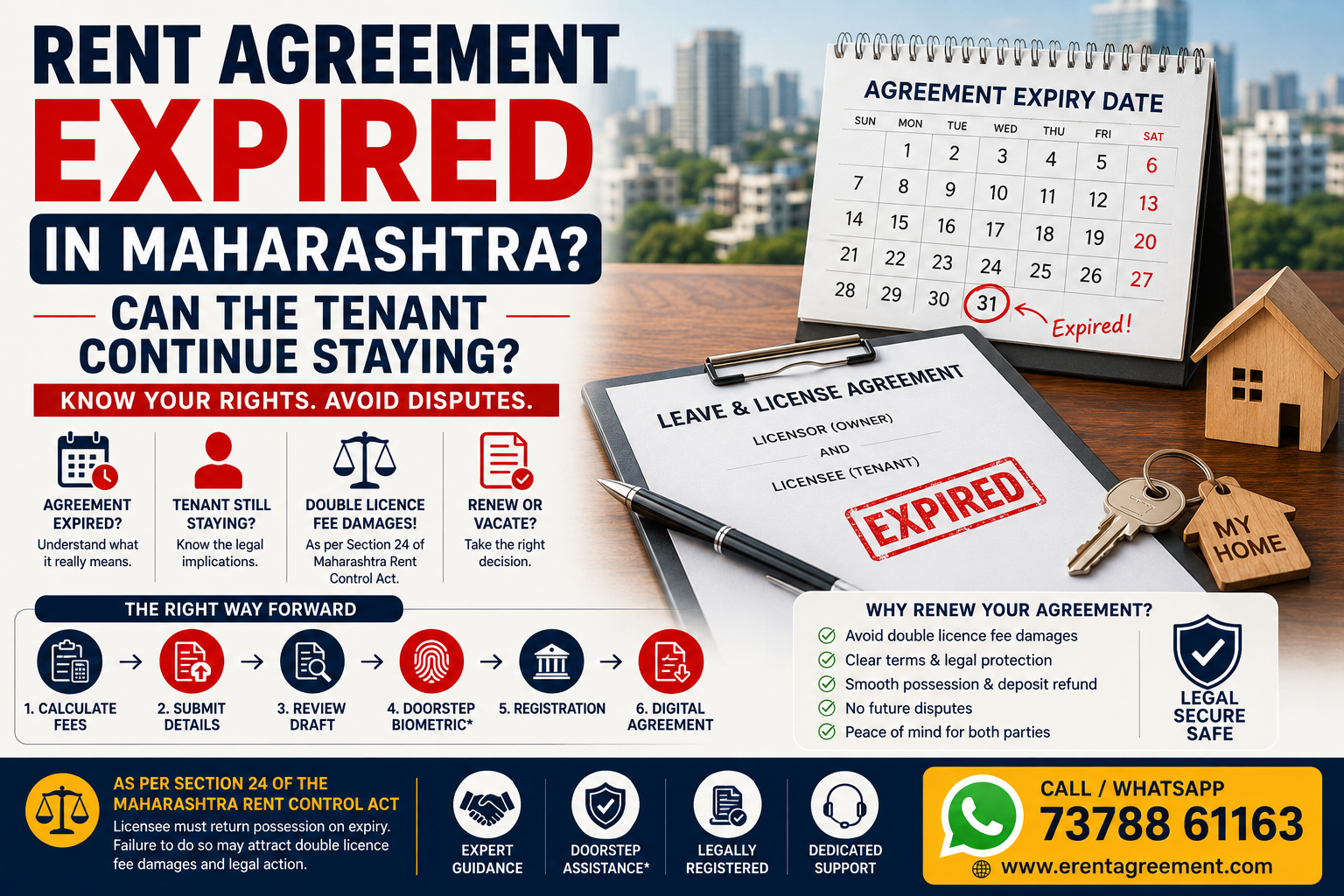
Rent Agreement Expired in Maharashtra? Can the Tenant Continue Staying? Complete Guide for Owners & Tenants
Description: What happens when a Maharashtra Leave & License Agreement expires but the tenant continues to stay? Understand possession, renewal, double licence-fee damages, notice, security deposit and the correct way to continue the rental arrangement.
Your Rent Agreement Has Expired — What Happens Next?
This is a very common situation.
The Owner and Tenant entered into an 11-month Registered Leave & License Agreement.
The expiry date arrives.
But:
- The Tenant is still living in the property.
- Rent is still being paid.
- The Owner has no immediate objection.
- Both parties intend to continue for another year.
- Nobody has prepared the renewal yet.
Many people assume:
“We are continuing the rent, so the old agreement automatically continues.”
That assumption can create unnecessary legal and practical problems.
For residential premises given on licence, Section 24 of the Maharashtra Rent Control Act, 1999 specifically states that the Licensee must deliver possession to the landlord when the licence period expires. If possession is not returned, the landlord may apply to the Competent Authority for recovery of possession.
So if both parties actually want to continue the rental relationship, the safer approach is simple:
Do not depend on an expired agreement. Create and register the fresh agreement in time.
First Understand: What Does “Expiry” Mean?
Suppose your agreement states:
Agreement Start Date: 1 October 2025
Agreement End Date: 31 August 2026
The contractual licence period ends on 31 August 2026.
From the next day, the original agreement has reached the end of the period written into it.
This is different from:
Cancellation
Ending the agreement before its scheduled expiry.
Notice
Advance communication that one party intends to terminate or vacate.
Renewal
Entering into a fresh arrangement for the next agreed period.
These concepts are connected, but they are not the same.
What Does Section 24 Say About an Expired Leave & License Agreement?
Section 24 of the Maharashtra Rent Control Act deals specifically with residential premises given on licence.
It provides that when the licence period expires, the Licensee should hand possession back to the landlord. If the Licensee does not do so, the landlord can approach the Competent Authority for recovery of possession.
The Maharashtra Rent Control Department itself explains the same position in its information concerning Section 24 proceedings.
This makes the expiry date written in the agreement extremely important.
Can the Tenant Simply Continue Staying After Expiry?
If both parties want to continue the arrangement, they should create a fresh agreement rather than casually relying on the expired document.
Why?
Because the old agreement records a licence period that has already ended.
A continuing arrangement may involve changed terms such as:
- New rent
- New tenure
- Revised security deposit
- New notice period
- New lock-in period
- Revised maintenance responsibility
- Different occupant
- New furniture
- New parking arrangement
- Updated clauses
The next rental period should therefore be properly documented.
Very Important: Double Licence-Fee Damages After Expiry
This is one of the most important provisions Owners and Tenants should understand.
Section 24(2) provides that where a residential Licensee does not deliver possession after expiry and continues in possession until dispossession through the Competent Authority, the Licensee can be liable for damages at double the rate of the licence fee or charge fixed under the agreement.
For example:
Licence Fee in Agreement
₹25,000 per month
Statutory damages contemplated under Section 24(2)
Potentially ₹50,000 per month during the period covered by that provision.
This is not the same thing as the Owner simply deciding to double the rent whenever an agreement expires.
It is a statutory damages provision that can apply in the circumstances described in Section 24.
Example: Tenant Continues Without Owner's Consent
Consider this scenario:
Agreement expires: 31 August
Owner tells Tenant:
“Please vacate as agreed.”
Tenant does not leave.
The Tenant continues occupying the property.
This is very different from a situation where both parties have already mutually decided to enter into a fresh agreement.
Section 24 gives the landlord a specific mechanism to seek recovery of possession when a Licensee remains after expiry.
Example: Both Owner and Tenant Want to Continue
Now consider another situation.
The agreement expires on 31 August.
The Owner says:
“I am happy to continue for another 12 months.”
The Tenant agrees.
The rent is increased from ₹25,000 to ₹27,000.
Here, the logical next step is not to leave the old agreement untouched.
Instead, prepare the fresh Leave & License Agreement showing:
New period
New rent
Deposit
Notice
Lock-in
Maintenance
Other agreed terms
and complete the applicable registration formalities.
Is Rent Agreement Renewal Just an Extension of the Old PDF?
No.
One of the biggest misconceptions is that renewal means:
Open the old agreement → Change the dates → Continue.
A new rental period is an opportunity to formally document the updated arrangement.
A fresh agreement may have:
- New execution date
- New commencement date
- New expiry date
- Revised rent
- Revised deposit terms
- Revised notice
- Revised lock-in
- Updated parties or occupants
- Updated clauses
Treat renewal as a fresh contractual period, not simply a cosmetic date change.
Should Biometric Be Done Again for Renewal?
Where the fresh Maharashtra Leave & License Agreement is being processed through the applicable electronic registration workflow, the required execution/authentication formalities for that fresh agreement must be completed according to the prevailing registration process.
Do not assume that biometrics/authentication completed for the earlier agreement automatically carries forward forever.
The earlier authentication related to the earlier agreement.
The fresh agreement is a new document.
When Should Renewal Be Started?
Do not wait until the final evening of the agreement.
A practical approach is to begin discussing renewal before the existing agreement expires.
For example:
30 Days Before Expiry
Owner and Tenant discuss whether they want to continue.
20–25 Days Before Expiry
Agree on:
- Rent increase
- Deposit
- Tenure
- Notice
- Lock-in
- Maintenance
10–15 Days Before Expiry
Prepare and review the draft.
Before / Around the New Term
Complete the applicable execution and registration process.
This prevents the parties from reaching the expiry date without knowing what happens next.
Does the Tenant Need to Give Notice When the Agreement Naturally Expires?
This depends on the agreement and circumstances.
There is an important difference between:
Ending the Agreement Early
and
Allowing It to Reach Its Agreed Expiry Date
Section 24 expressly deals with delivery of possession on expiry of the residential licence period.
However, the agreement may also contain practical notice requirements relating to:
- Renewal
- Non-renewal
- Vacation
- Early termination
For this reason, always read the Notice Period, Cancellation Clause and Expiry Clause together.
Notice Period Does Not Automatically Extend the Agreement
Suppose:
Agreement expiry: 31 August
Notice period: 1 month
A Tenant should not automatically assume:
“Because the notice period is one month, I can stay until 30 September after the agreement expires.”
The notice clause has to be interpreted according to its wording and purpose.
An agreement's scheduled expiry date and an early-termination notice period are not automatically interchangeable.
Lock-in Period Also Ends Differently
Example:
Agreement: 24 months
Lock-in: First 12 months
Notice: 2 months
A lock-in provision primarily governs early exit during the agreed period.
Once the full licence itself expires, you are dealing with expiry, not simply lock-in.
That is why these clauses should never be read in isolation.
Can the Owner Accept Rent After Expiry?
Real-life arrangements can become complicated when the Owner continues receiving payments after the written agreement has expired.
Do not assume that receiving or paying money automatically solves every legal question surrounding the expired licence.
If both parties intend to continue, the most practical way to remove ambiguity is:
Agree the new terms.
Prepare the fresh agreement.
Complete the applicable registration process.
Maintain clear payment records.
For an actual dispute involving post-expiry payments or possession, the parties should obtain advice from a practising advocate.
What If the Owner Does Not Want to Renew?
The Tenant should plan to return possession according to the agreement and applicable law.
A proper move-out process may include:
Property Inspection
Check the condition of the premises.
Outstanding Rent
Settle any unpaid amounts.
Electricity Bill
Record the final meter reading and settle applicable dues.
Society / Maintenance Dues
Confirm agreed responsibilities.
Furniture Inventory
Check all listed items.
Keys
Return all keys, access cards and parking remotes.
Security Deposit
Calculate the refundable amount and agreed deductions.
Possession Handover
Record the date the property was returned.
This is much better than simply handing over a key without documentation.
Security Deposit After Agreement Expiry
Expiry of the agreement does not mean deposit settlement should become unclear.
The agreement should already specify:
- When the deposit will be refunded
- What amounts may be deducted
- How damage will be assessed
- Who pays outstanding utilities
- How possession will be confirmed
At move-out, both parties should reconcile the account.
For example:
Security Deposit: ₹1,00,000
Less:
Pending electricity: ₹2,400
Agreed damage: ₹3,000
Balance Refund: ₹94,600
Document the calculation.
What If the Tenant Wants to Renew but the Owner Does Not?
Renewal should not be assumed to be automatic merely because one party wants to continue.
The next rental period requires the Owner and Tenant to agree on the new arrangement.
The Owner may decide:
- To occupy the property personally
- To sell the property
- To give it to another Tenant
- To revise the rent
- Not to continue the arrangement
Likewise, the Tenant may decide not to renew.
Discuss renewal before the contractual expiry date.
What If the Owner Wants Renewal but the Tenant Wants to Leave?
Then the Tenant should follow the agreement's applicable exit and possession requirements.
Before vacating:
📸 Take property photographs
📹 Consider a short handover video
⚡ Record electricity meter
🪑 Check inventory
🔑 Return keys
🧾 Obtain acknowledgement of possession
💰 Document deposit settlement
These records protect both sides.
Can the Fresh Agreement Have Different Rent?
Yes.
The Owner and Tenant may mutually agree to different commercial terms for the new period.
For example:
Previous Agreement
₹25,000/month
Fresh Agreement
₹26,250/month
Or the parties may agree on another amount.
The new rent should be clearly written into the fresh agreement.
Is a 5% or 10% Increase Mandatory on Renewal?
Do not assume that a fixed annual percentage automatically applies to every property.
The revised rent should follow:
- The existing agreement, where applicable
- The parties' mutual arrangement
- Applicable law
If the new rent is different, write the exact amount into the fresh agreement.
Do not leave the increase open to interpretation.
Can the Deposit Stay the Same?
Yes, if the parties agree.
Example:
Old Agreement
Rent: ₹25,000
Deposit: ₹75,000
Fresh Agreement
Rent: ₹27,000
Deposit: ₹75,000
The parties may agree to keep the deposit unchanged.
Alternatively, they may increase or reduce it.
The fresh agreement should clearly record the agreed amount.
What About the Old Security Deposit?
If the same Owner and Tenant continue, they may agree that the existing refundable deposit will continue to be held for the fresh agreement.
If that is the arrangement, document it clearly.
Do not leave the Tenant wondering:
“Was my old deposit technically refunded?”
and the Owner thinking:
“I assumed it automatically transferred.”
Clear writing removes the question.
Furniture Can Change During Renewal
Renewal is also the perfect time to update the inventory.
Perhaps the Owner has added:
- New refrigerator
- New air-conditioner
- New bed
- New television
Or removed:
- Washing machine
- Dining table
- Sofa
The fresh inventory should reflect what is actually present at the start of the new period.
Use Renewal to Fix Weak Clauses
If the previous agreement caused confusion, do not repeat the same mistake.
For example:
Old Agreement
“Tenant shall pay maintenance.”
But there are actually two types:
- Society maintenance
- Usage-related charges
The fresh agreement can define each responsibility separately.
Review These Terms Before Renewal
Before preparing the fresh agreement, Owner and Tenant should confirm:
1. New Agreement Tenure
How long will the next term be?
2. New Monthly Rent
Is there an increase?
3. Security Deposit
Same or revised?
4. Notice Period
30 days? 60 days? Another period?
5. Lock-in
Will there be one?
6. Maintenance
Who pays what?
7. Utilities
Electricity, gas, water, internet.
8. Repairs
Owner vs Tenant responsibility.
9. Furniture
Update inventory.
10. Special Conditions
Pets, parking, occupancy, guests, property use, etc.
Can You Backdate the Renewal?
Do not intentionally enter false dates merely to make the paperwork appear as though it was completed earlier.
Where a delayed document needs to record an earlier actual commencement or execution arrangement, the applicable registration and stamping rules need to be considered carefully.
If the earlier agreement has already expired and the parties have continued, provide the true facts when preparing the fresh document and obtain appropriate professional guidance where necessary.
What if the Agreement Has Been Expired for Several Months?
The longer the gap, the more important it becomes to stop relying on assumptions.
Confirm:
- When the earlier agreement expired
- Whether the Tenant is still occupying
- What rent has been paid
- Whether the Owner consented to continuation
- What terms now apply
- Whether either party wants to terminate
- Whether a fresh agreement is being created
Where there is disagreement, obtain legal advice rather than trying to retrospectively rewrite the history.
Written Agreement Is Particularly Important
Section 24's explanation provides that an agreement of licence in writing is conclusive evidence of the facts stated in it for the purposes of that section.
This is another reason the dates and terms in the agreement should be accurate.
The agreement may become important evidence if possession later becomes disputed.
Owners: Don't Ignore the Expiry Date
Owners should maintain a simple reminder:
45 Days Before Expiry
Discuss renewal.
30 Days Before Expiry
Finalize commercial terms.
15 Days Before Expiry
Review fresh agreement.
Expiry / New Term
Complete the relevant process and update documentation.
Do not discover three months later that the agreement expired and nobody did anything.
Tenants: Don't Assume Renewal
Tenants should also monitor the expiry date.
Before making future plans, ask the Owner:
“Are we renewing the agreement?”
Confirm:
- New rent
- New tenure
- Deposit
- Notice
- Lock-in
- Any changed terms
Do this before the expiry date.
A Simple Rent Agreement Renewal Process
With erentagreement.com, the process can be coordinated in a straightforward sequence:
Step 1 — Confirm Renewal
Owner and Tenant agree to continue.
Step 2 — Confirm New Terms
Rent, tenure, deposit, notice and other conditions.
Step 3 — Submit Details
Provide the required Owner, Tenant, witnesses and property information.
Step 4 — Draft Preparation
Fresh agreement is prepared.
Step 5 — Review & Approve
Both parties check the complete draft.
Step 6 — Complete Biometric / Authentication*
Coordinate the applicable process.
Step 7 — Registration
Fresh agreement proceeds for registration.
Step 8 — Receive Digital Copy
Receive the registered agreement after completion.
Frequently Asked Questions
Does a Maharashtra Rent Agreement automatically renew after expiry?
Do not assume automatic renewal. A Leave & License Agreement has a defined licence period, and Section 24 specifically addresses the Licensee's obligation to return possession upon expiry. If both parties intend to continue, document the fresh arrangement properly.
Can a Tenant stay after the agreement expires?
If the Owner and Tenant want the rental relationship to continue, a fresh agreement should be prepared. If the Licensee remains after expiry without returning possession, Section 24 provides a possession-recovery mechanism for the landlord.
Can the Owner charge double rent after expiry?
Section 24(2) contains a provision for damages at double the agreed licence fee where the Licensee does not return possession after expiry and remains until dispossession through the Competent Authority. This should not be misunderstood as a general right to arbitrarily double monthly rent in every post-expiry situation.
Is renewal just changing the date on the old agreement?
No. The fresh rental period should accurately record the new commercial arrangement and complete the applicable documentation and registration process.
Can the rent change during renewal?
Yes, the parties may agree on a revised rent for the fresh period.
Can the deposit remain unchanged?
Yes, if both parties mutually agree and clearly document it.
Should furniture be reviewed on renewal?
Yes, particularly for furnished properties. Update the inventory if items have been added, removed or replaced.
Renew Before Your Agreement Expires
An expired Rent Agreement should not become something you notice only when:
- The Tenant wants to vacate
- The Owner wants possession
- The deposit is being refunded
- A dispute occurs
- A society asks for documentation
- Someone suddenly needs the agreement
Treat the expiry date as an important rental-management milestone.
Renewing? Create the fresh agreement.
Vacating? Complete the handover.
Disagreement? Get legal advice promptly.
How eRent Agreement Can Help
With erentagreement.com, Owners and Tenants can get assistance with:
🏠 Fresh Registered Leave & License Agreements
🔄 Rent Agreement Renewal
📝 Draft Review Before Registration
💰 Revised Rent & Deposit Terms
🔒 Lock-in & Notice Clauses
🖐️ Doorstep Biometric Coordination*
🏛️ Registration Assistance
🌍 NRI & Outstation Coordination*
📧 Digital Agreement Delivery
🎁 FREE Virtual Consultation with a Practising Advocate worth ₹599* after successful agreement completion and during the agreement tenure, subject to applicable terms.
📞 Call / WhatsApp: 7378861163
🌐 www.erentagreement.com
Final Takeaway
A Rent Agreement has a start date and an expiry date for a reason.
Do not treat the expiry date as merely another day on the calendar.
If the Tenant is leaving:
Inspect → Settle → Return Keys → Handover Possession
If both parties are continuing:
Agree New Terms → Draft → Review → Register the Fresh Agreement
And if possession continues despite expiry against the Owner's wishes, Section 24 of the Maharashtra Rent Control Act provides specific remedies and potential double licence-fee damages in the circumstances covered by that provision.
Don't let your Rent Agreement expire silently. Renew it or close it properly.
Disclaimer: This article provides general educational information and is not legal advice. The legal consequences of continued occupation, payments, termination, renewal or possession depend on the agreement and facts of each case. Parties facing an actual possession or termination dispute should consult a practising advocate.
Primary Keyword: Rent Agreement Expired in Maharashtra
Secondary Keywords: expired rent agreement Maharashtra, Leave and License Agreement expired, tenant staying after agreement expiry, rent agreement renewal Maharashtra, expired rental agreement Pune, Maharashtra Section 24 rent agreement

 +91-7378861163
  info@erentagreement.com
  8:00AM - 9:00PM