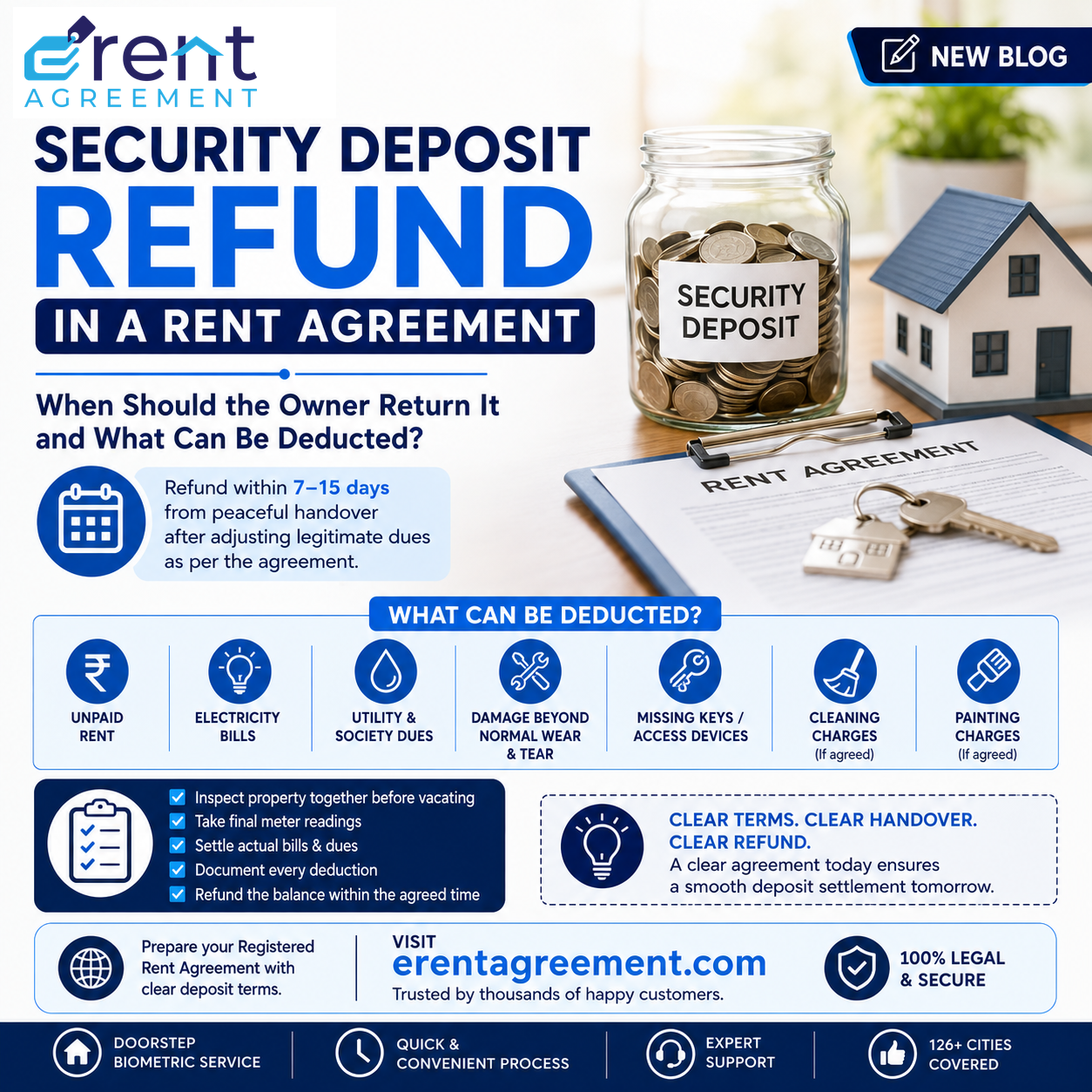
Security Deposit Refund in a Rent Agreement: When Should the Owner Return It and What Can Be Deducted?
Questions often arise such as:
When should the owner return the deposit?
Can the owner deduct repair costs?
Can unpaid electricity or maintenance be deducted?
What about painting charges?
What if the tenant damaged furniture?
Can the owner hold the complete deposit until all bills are received?
The first place both parties should look is the Rent Agreement / Leave and License Agreement.
If the agreement clearly states when the deposit will be refunded and what deductions are permitted, both parties should generally follow the mutually agreed terms, subject to applicable law.
At ERENTAGREEMENT, we recommend that deposit refund conditions be clearly written into the agreement before the tenant takes possession.
What Is a Security Deposit in a Rent Agreement?
A security deposit is an amount paid by the tenant to the property owner at the beginning of the tenancy.
It acts as security against possible liabilities such as:
- Unpaid rent
- Unpaid electricity charges
- Outstanding utility bills
- Society-related dues payable by the tenant
- Tenant-caused property damage
- Missing furniture or fixtures
- Key replacement
- Other agreed liabilities
The deposit is not automatically an additional payment to the property owner.
Subject to the agreement and legitimate deductions, the balance should be returned to the tenant when the tenancy ends and possession is handed back.
First Rule: Check What the Rent Agreement Says
Before arguing about when or how the deposit should be refunded, read the relevant agreement clauses.
A well-written clause may specify:
- Deposit amount
- Whether the deposit is interest-free
- When it will be refunded
- Permitted deductions
- Condition of handover
- Outstanding utility adjustments
- Repair responsibilities
- Painting or cleaning conditions
For example, the agreement may state:
The security deposit shall be refunded within 7 days from peaceful handover of vacant possession, after adjustment of unpaid rent, electricity charges and damage beyond normal wear and tear.
If both parties have agreed to such terms, those terms should guide the settlement.
When Should the Security Deposit Be Returned?
There is no practical reason for the owner to hold the deposit indefinitely after:
- Tenant has vacated
- Keys have been returned
- Property has been inspected
- Rent is fully paid
- Known utility liabilities are settled
The exact refund period should ideally be written into the agreement.
Commonly agreed arrangements include:
Same-Day Refund
Deposit is refunded at the time possession and keys are handed back, after agreed deductions.
Within 7 Days
The owner is allowed a short period to inspect the property and calculate dues.
Within 7–15 Days
This may be used where final electricity, gas, society or repair amounts still need to be confirmed.
The important thing is to avoid vague wording such as:
“Deposit will be refunded later.”
Instead, specify an actual timeframe.
A Good Deposit Refund Clause Should Be Clear
Rather than writing:
“Deposit will be returned after vacating.”
a clearer clause can state:
The Licensor shall refund the security deposit to the Licensee within 7 days from the date of peaceful handover of vacant possession and return of keys, after adjustment of unpaid rent, electricity charges, society dues payable by the Licensee, damage beyond normal wear and tear and other amounts expressly payable by the Licensee under this Agreement.
The exact wording should reflect what both parties agree to.
What Can Be Deducted From the Security Deposit?
The answer depends on the agreement and the reason for the deduction.
Commonly disputed items include the following.
1. Unpaid Rent
If the tenant has not paid the final month's rent or another outstanding rent amount, the owner may generally seek adjustment from the deposit where permitted by the agreement.
For example:
Deposit: ₹60,000
Outstanding Rent: ₹25,000
After other legitimate adjustments, the unpaid rent may be deducted before returning the balance.
2. Unpaid Electricity Charges
Electricity consumed by the tenant during the tenancy is generally the tenant's responsibility where the agreement says so.
If the final electricity bill remains unpaid at the time of vacating, the amount may be adjusted from the security deposit.
A better practice is to:
Take meter reading → Check final bill → Pay/adjust exact amount → Share proof
This avoids arbitrary deductions.
'3. Water, Gas and Utility Bills
The same principle may apply to:
- Gas bills
- Water charges
- Internet bills
- Other utilities payable by the tenant
Only amounts that are actually attributable to the tenant should be considered.
4. Society Dues Payable by the Tenant
Rent Agreements should clearly distinguish:
Society maintenance payable by owner
from
Charges specifically payable by tenant
If the agreement requires the tenant to pay certain society charges and those remain outstanding, the amount may be adjusted accordingly.
5. Damage Caused by the Tenant
If the tenant damages the property beyond ordinary wear and tear, repair costs may be deducted, subject to the agreement and actual circumstances.
Examples may include:
- Broken door
- Damaged cupboard
- Broken window
- Damaged furniture
- Broken sanitary fitting
- Unauthorized wall damage
- Damage caused by negligence
The owner should ideally support deductions with:
Photos + inspection record + repair estimate/invoice
Normal Wear and Tear Is Different From Damage
This distinction is extremely important.
A property naturally changes with regular use.
Normal Wear and Tear Examples
- Minor paint fading
- Small signs of ordinary usage
- Natural ageing of fittings
- Minor deterioration over time
Possible Tenant-Caused Damage
- Broken fixtures
- Large wall holes
- Damaged furniture
- Cracked fittings caused by misuse
- Unauthorized alterations
- Damage caused by negligence
The tenant should not automatically be charged for every sign that somebody lived in the property.
6. Missing Keys or Access Devices
If the tenant fails to return:
- Main door keys
- Duplicate keys
- Access cards
- Parking remotes
- Society access tags
the reasonable replacement cost may be recoverable where applicable.
Again, it is better to record what was handed over at possession.
7. Cleaning Charges
Cleaning is another common source of disagreement.
If the Rent Agreement specifically requires the tenant to return the property in a professionally cleaned condition, the agreed obligation should be followed.
However, if the agreement says nothing about professional cleaning, both parties should avoid introducing unexpected charges only when the tenant is vacating.
The condition should ideally be discussed and documented at the beginning.
8. Painting Charges
Many disagreements occur because one party assumes painting is automatically the tenant's responsibility.
It is better to clearly state in the agreement whether:
- Tenant must repaint before vacating
- Painting cost may be deducted
- Only damage beyond normal wear is recoverable
- Owner will bear normal repainting expenses
Do not leave this to assumption.
Existing Damage Should Not Be Charged to the Tenant
This is why a move-in inspection is extremely important.
Before taking possession, the tenant should identify existing issues such as:
- Wall damage
- Seepage
- Broken fittings
- Scratches
- Non-working appliances
- Damaged furniture
- Existing stains
Record them through:
Photos + Videos + WhatsApp/Email + Condition Checklist
Otherwise, months later it may be difficult to establish whether the damage existed before the tenant moved in.
Example: Why Move-In Photos Matter
Suppose a tenant vacates after 11 months.
The owner notices a crack in a bedroom wardrobe and says:
“This was damaged by the tenant.”
The tenant says:
“It was already cracked when I moved in.”
If the tenant has a dated photograph from the possession date, the disagreement can often be resolved quickly.
Without documentation, it becomes one person's word against another.
Conduct a Move-Out Inspection
Before the tenant vacates completely, both parties should ideally inspect the property together.
Check:
- Walls
- Ceiling
- Floors
- Doors
- Windows
- Taps
- Bathroom fittings
- Kitchen
- Cupboards
- Furniture
- Appliances
- Keys
- Meter readings
Any disagreement should be documented immediately.
This is much better than discovering issues after the tenant has left the city.
Create a Final Handover Checklist
A simple handover record can include:
Item
Status
Rent Paid
Yes
Electricity Bill
Cleared
Gas Bill
Cleared
Keys Returned
Yes
Furniture Checked
Yes
Appliances Checked
Yes
Property Damage
None / Mention
Final Meter Reading
Recorded
Deposit
₹___
Deductions
₹___
Refund Amount
₹___
Both parties should retain a copy.
Can the Owner Deduct Repair Costs?
Yes, where the tenant is legitimately responsible for the damage.
However, remember the distinction discussed in our repair-responsibility guide.
Minor Daily Repairs
Examples such as a small tap washer, clogged drain caused by usage or similar routine issues may generally be tenant-related where the agreement is silent.
Major Structural Repairs
Problems such as:
- Ceiling leakage
- Concealed pipe burst
- Structural seepage
- Waterproofing failure
would normally require owner involvement unless caused by the tenant.
A security deposit should not automatically be used to make the tenant pay for a major structural problem that was not their responsibility.
What If Repairs Are Mentioned in the Agreement?
Then start with the agreement.
For example, if the agreement clearly states:
Minor day-to-day repairs shall be borne by the tenant, while major structural repairs shall be borne by the owner.
the deposit calculation should follow that allocation.
This is another reason a properly drafted agreement matters.
Can the Owner Hold the Full Deposit Until the Final Electricity Bill Arrives?
Sometimes the final bill may not have been generated on the exact possession-handover date.
Rather than holding a very large deposit unnecessarily, both parties can agree on a practical arrangement.
For example:
Deposit: ₹1,00,000
Expected Final Electricity Liability: approximately ₹2,000
The owner and tenant may agree to retain a reasonable estimated amount temporarily and refund the majority of the deposit immediately.
The balance can then be settled after the final bill.
The exact arrangement should be mutually documented.
What If the Owner Does Not Return the Deposit?
First review:
- Agreement terms
- Refund timeframe
- Deductions claimed
- Proof of payment
- Handover evidence
- Communication between parties
The tenant should request:
Written calculation of deductions + Supporting bills/estimates + Refund of undisputed balance
If the dispute cannot be resolved, the parties may consider obtaining appropriate legal advice based on the agreement and circumstances.
What If the Tenant Has Not Paid the Last Month’s Rent?
Some tenants assume:
“The owner already has my deposit, so I don't need to pay the final rent.”
This is not automatically correct.
Unless both parties expressly agree to adjust rent against the deposit, the tenant should continue paying rent according to the agreement.
Security deposit and monthly rent are separate obligations.
If both parties want the final rent adjusted from the deposit, document that agreement clearly.
Never Assume Deposit = Last Month’s Rent
This is an important practical rule.
For example:
Rent: ₹30,000
Deposit: ₹90,000
The tenant cannot automatically decide:
“I will not pay the last three months because the owner already has ₹90,000.”
The deposit exists as security.
Any adjustment should be mutually agreed.
What If the Tenant Leaves Before the Notice Period?
If the agreement contains a notice-period or lock-in provision and the tenant leaves without complying with it, the financial consequences depend on the actual agreement terms and applicable circumstances.
Do not automatically make arbitrary deductions.
The owner should refer to the specific contractual provision.
Deposit Refund and Lock-In Period
Lock-in and security deposit are separate concepts.
Suppose the agreement provides:
Lock-In: 6 months
If the tenant leaves during that period, the consequences should be determined from the actual lock-in clause.
The owner should not assume that the entire security deposit can automatically be forfeited unless the agreement and applicable law support that conclusion.
Clear drafting is essential.
Best Practice for Property Owners
At possession:
✅ Inspect property with tenant
✅ Create inventory
✅ Record meter readings
✅ Photograph property condition
✅ Keep communication documented
At vacating:
✅ Conduct joint inspection
✅ Record final meter reading
✅ Calculate actual dues
✅ Explain every deduction
✅ Refund the balance within the agreed period
Transparency reduces disputes.
Best Practice for Tenants
Before moving in:
✅ Check everything
✅ Photograph existing damage
✅ Report non-working items immediately
✅ Keep payment receipts
Before moving out:
✅ Give proper notice
✅ Pay agreed rent/utilities
✅ Clean the property as required
✅ Return all keys
✅ Participate in final inspection
✅ Request written deposit settlement
A Strong Security Deposit Clause Can Prevent Disputes
Instead of writing a vague line, consider a detailed mutually agreed clause such as:
The security deposit shall be refunded to the Licensee within 7 days from peaceful handover of vacant possession and return of keys, after adjustment of unpaid rent, electricity and utility charges payable by the Licensee, documented damage beyond normal wear and tear and other amounts expressly payable under this Agreement. The Licensor shall provide details of deductions, if any, to the Licensee.
The actual clause should always reflect the understanding between the owner and tenant.
Frequently Asked Questions
When should a landlord return the security deposit?
The timeframe should ideally be clearly mentioned in the Rent Agreement. Both parties may agree to same-day refund, 7 days, 7–15 days or another reasonable period depending on pending bills and inspection.
Can electricity bills be deducted from the deposit?
Outstanding electricity consumed by the tenant may generally be adjusted where it is the tenant's responsibility under the agreement.
Can painting charges be deducted?
That depends on the agreement, property condition and whether the tenant caused damage beyond ordinary wear.
Can the owner deduct repair expenses?
Legitimate tenant-caused damage may be deductible. Major structural repairs that are the owner's responsibility should not normally be shifted to the tenant without justification.
Can rent be adjusted against the security deposit?
Only if the parties agree or the agreement provides for such adjustment. Tenants should not unilaterally stop paying rent simply because the owner holds a deposit.
What if some utility bills are still pending?
The parties can agree on a reasonable temporary retention and refund the remaining undisputed deposit instead of unnecessarily holding the entire amount.
Should tenants take photographs when moving in?
Yes. A photographic condition record is one of the simplest ways to prevent future disputes.
Clear Deposit Terms = Fewer Disputes
Security deposit disputes are often caused not by bad intentions but by unclear expectations.
The best approach is to decide everything before possession:
How much is the deposit?
When will it be returned?
What can be deducted?
Who pays repairs?
What about painting?
What happens with pending utility bills?
Write these terms clearly into your Rent Agreement.
With ERENTAGREEMENT, owners and tenants can prepare a customized Registered Rent Agreement that clearly reflects their mutually agreed terms.
👉 Visit erentagreement.com to calculate your fees and start your Registered Rent Agreement.
Clear Terms. Clear Handover. Clear Deposit Settlement.
Description:
When should a rental security deposit be returned? Learn what owners can deduct for unpaid rent, electricity, repairs, painting, damage and how tenants can protect their deposit.
Primary Keyword:
Security Deposit Refund Rent Agreement
Secondary Keywords:
Rent Agreement Security Deposit
Security Deposit Refund Tenant
Landlord Security Deposit Deduction
Can Owner Deduct Repair Cost From Deposit
Rent Deposit Refund India
Security Deposit Owner Tenant
Painting Charges Security Deposit
Electricity Bill Deposit Deduction
Rental Property Security Deposit
Leave and License Security Deposit Maharashtra
Preparing a new Rent Agreement? Clearly define deposit refund timelines and permitted deductions before possession is handed over. Start at erentagreement.com.

 +91-7378861163
  info@erentagreement.com
  8:00AM - 9:00PM