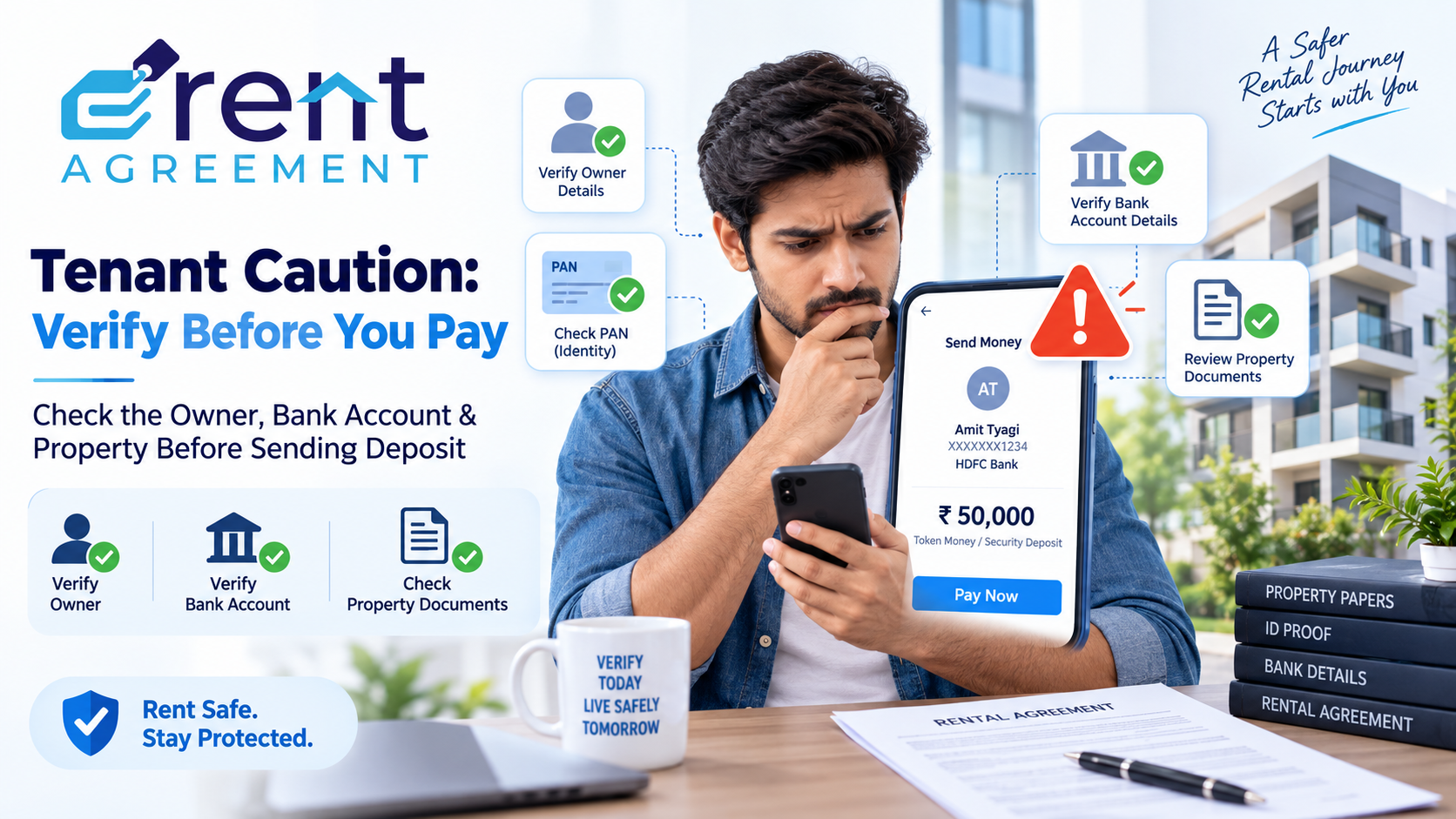
⚠️ Tenant Caution: Don’t Transfer Token or Security Deposit Until You Verify the Owner, Bank Account & Property
Meta Description: Before paying token money, advance rent or a security deposit for a Maharashtra rental property, verify the owner, payment account, property details and Rent Agreement terms. Learn the checks tenants should complete before transferring money.
🚨 Tenant Caution: “Pay the Deposit First, Agreement Later” Should Make You Stop and Check
You found a beautiful flat.
Location is perfect.
Rent is within budget.
The Owner or Broker says:
“Sir, property demand mein hai. ₹50,000 token abhi transfer karo, agreement baad mein ho jayega.”
You are worried someone else will take the property.
So you open your banking app.
But before pressing TRANSFER, stop.
Never let urgency replace verification.
A rental property may look genuine.
The person may sound genuine.
The WhatsApp profile may look genuine.
The bank account may even have the same surname.
But before transferring a substantial token, security deposit or advance rent, a Tenant should perform reasonable checks.
The Cautionary Sentence Every Tenant Should Remember
⚠️ Verify the Person. Verify the Payment Account. Verify the Property. Then Finalize the Agreement and Payment.
A few minutes of checking can be far easier than trying to recover money after it has gone to the wrong person.
Why Rental Payments Need Extra Caution
Rental transactions often happen quickly.
A tenant may see the property in the morning and be asked to transfer money the same evening.
Common pressure statements include:
“Three more tenants are interested.”
“Pay token now or property will be gone.”
“Agreement can happen later.”
“Owner is abroad, send money to this account.”
“My brother manages the property, transfer to him.”
Some of these situations may be completely genuine.
But they deserve verification before payment, not after it.
Check 1: Who Are You Actually Dealing With?
Before transferring money, determine whether the person asking for payment is:
The Property Owner
or
A Co-owner
or
A Power of Attorney Holder
or
An Authorized Representative
or
A Broker
These are not interchangeable roles.
If a broker showed you the property, that does not automatically mean money should be transferred to the broker.
If a relative is managing the property, understand the authority under which that person is acting.
Check 2: Verify the Owner’s Identity
Ask for appropriate identification/documentation.
Depending on the transaction, this may include:
- PAN
- Aadhaar or other applicable identification
- Name appearing on relevant property documentation
- Contact details
Check whether the names are reasonably consistent.
For example:
Property Record: Amit Kumar Sharma
PAN: Amit Kumar Sharma
Bank Account: Amit Kumar Sharma
This is easier to understand than:
Property Owner: Amit Sharma
Payment requested to: XYZ Services
WhatsApp contact: Someone else
A mismatch does not automatically mean fraud.
But it means:
Ask why before paying.
Check 3: Verify the Bank Account Before Transferring a Large Deposit
Imagine the Owner tells you:
“Transfer ₹2,00,000 security deposit to this bank account.”
Before making a large payment, verify that you understand:
- Account holder name
- Bank
- Account number
- IFSC
- Why this account is receiving the payment
- Relationship between account holder and Owner, if different
A verified bank account can reduce payment-routing mistakes.
However:
⚠️ Bank Account Verification Does NOT Prove Property Ownership.
It verifies banking-related information—not title to the property.
That distinction is extremely important.
Check 4: Verify the Property Details Separately
A person's PAN and bank account may be genuine, while the question:
“Does this person actually have the authority to rent this property?”
still needs separate consideration.
Depending on the property, available records may include:
- Property Card
- Index II
- Previous registered documents
- Society/property records
- Electricity bill
- Other supporting ownership/authority documents
The exact document set can differ by property type.
Don’t Make This Mistake
A tenant verifies the Owner's PAN successfully.
Then thinks:
“PAN verified, so ownership is also verified.”
That is not correct.
PAN verification helps establish PAN-related identity information.
It does not by itself prove ownership of a flat.
The same is true for bank-account verification.
Think of Verification in Layers
A safer rental transaction can be thought of as:
PERSON → PAYMENT ACCOUNT → PROPERTY → AUTHORITY → AGREEMENT → PAYMENT/POSSESSION
Each layer answers a different question.
Person
Who am I dealing with?
Payment Account
Where is my money going?
Property
Which property is involved?
Authority
Does this person have authority to give the property on rent?
Agreement
What exactly have we agreed?
Payment / Possession
Now execute the transaction.
Example: Everything Looks Genuine — Except the Bank Account
Suppose:
Property: Baner, Pune
Monthly Rent: ₹38,000
Deposit: ₹1,00,000
The Owner's documents show:
Mr. Rajesh Mehta
But the payment message says:
“Deposit transfer to Neha Enterprises.”
Ask for clarification.
There could be a perfectly legitimate explanation.
But a large payment should not rely on:
“Don't worry, that's our account.”
Get the reason clearly documented.
Example: Owner Is in the USA
This situation is common.
Property: Pune
Owner: USA
Tenant: Pune
A local person tells the Tenant:
“Owner is abroad. Transfer deposit to me. I'll handle everything.”
Before payment, ask:
- Who is this person?
- Is there a POA?
- Is there written authorization?
- Has the Owner confirmed the arrangement?
- Who will execute the Rent Agreement?
- Who should legally receive the deposit?
Distance is not a reason to reduce verification.
If anything, it is a reason to be more systematic.
Example: Broker Requests the Full Deposit
A Broker helps find the property.
Then says:
“Send deposit to me. I will transfer it to the Owner.”
This creates another layer in the transaction.
Ask:
Why isn't the payment going directly to the appropriate Owner/account?
Is the Owner aware?
Will you receive a proper acknowledgment?
What amount is brokerage and what amount is deposit?
Never mix:
Brokerage
with
Security Deposit
without clear documentation.
Token Money Requires Clarity Too
Tenants often think:
“It's only ₹10,000 token.”
But token disputes happen too.
Before sending token money, clarify:
- Is it refundable?
- Under what circumstances?
- What if the Owner cancels?
- What if the Tenant cancels?
- Will it be adjusted against deposit?
- Will it be adjusted against rent?
- Is brokerage separate?
- What happens if the agreement terms are not finalized?
Avoid transferring money based only on:
“Token bhejo, details baad mein decide karenge.”
Take Written Confirmation
When making a significant payment, keep proper evidence.
For example:
₹50,000 received as part of the refundable security deposit for Flat No. ___, subject to execution of the Rent Agreement.
This is far clearer than a bank transfer with no context.
Where appropriate, use:
- Written acknowledgment
- Email
- Agreement
- Payment receipt
- Properly documented WhatsApp confirmation
Verify Before You Sign — But Also Read Before You Sign
Verification does not replace agreement review.
Imagine the Owner is genuine.
The property is genuine.
The bank account is genuine.
But the Agreement says:
90-day notice
when you expected:
30-day notice.
Or:
11-month lock-in
when you never agreed to a lock-in.
The transaction may be genuine but the terms may still be wrong.
Always review the draft.
Before Paying the Full Deposit, Check the Draft
Review at least:
Monthly Rent
Security Deposit
Start Date
Tenure
Notice Period
Lock-in Period
Maintenance
Electricity / Utilities
Deposit Refund Terms
Damage Deductions
Painting / Cleaning
Parking
Furniture Inventory
Restrictions
Early Exit Terms
Don't Assume a WhatsApp Chat Replaces a Rent Agreement
WhatsApp is useful for communication.
But imagine trying to reconstruct a tenancy from 250 messages:
“30 days okay?”
“Yes.”
“Painting later discuss.”
“Fine.”
“Deposit 1 lakh?”
“Okay.”
A properly drafted Rent Agreement puts the key terms into one structured document.
Property Visit Is Also Part of Due Diligence
Where possible, physically inspect the property—or have a trusted person inspect it.
Check:
- Flat number
- Building
- Condition
- Furnishings
- Parking
- Society
- Access
- Meter
- Existing damage
Be cautious if someone repeatedly refuses physical/video verification while demanding immediate payment.
Beware of “Too Good to Be True” Rental Deals
Imagine the normal rent in an area is:
₹45,000/month
but a listing offers the same type of apartment for:
₹22,000/month
with the condition:
“Owner abroad. Property can only be reserved after ₹50,000 transfer.”
A low price by itself does not prove fraud.
But unusual pricing + urgency + remote Owner + advance payment is enough reason to perform deeper checks.
Do Not Share Sensitive Documents Carelessly
Verification works both ways.
Owners may need Tenant documents.
Tenants may request Owner/property documents.
But nobody should casually send sensitive documents to random people without understanding:
- Who is collecting them
- Why they are required
- Where they will be stored
- How they will be used
Use trusted channels and avoid unnecessary circulation of identity documents.
Tenant Verification Is Not Only for Owners
We often hear:
“Owner should verify Tenant.”
Correct.
But responsible renting is a two-way process.
Owner should reasonably verify Tenant.
And:
Tenant should reasonably verify Owner / authority / payment details.
Neither party should blindly trust the other simply because the property visit went well.
Before Paying ₹2 Lakh, Spend 10 Minutes Checking ₹2 Lakh
This is the mindset tenants should adopt.
People compare:
₹500 restaurant bills.
₹1,000 online purchases.
₹5,000 electronics.
But sometimes transfer:
₹1,50,000 deposit
after a five-minute WhatsApp conversation.
Rental transactions deserve proper due diligence.
How Lexaltis Verification Can Help
For additional document/payment-account checks, verification.lexaltis.com provides verification services such as applicable:
- PAN Verification
- Bank Account Verification
- IFSC Verification
- Other supported identity/business verification services
These checks can add another layer of due diligence.
However:
⚠️ Private verification does not replace property-title verification, legal due diligence, police requirements or government records.
Use it as an additional check—not as a declaration of property ownership.
Then Complete the Registered Rent Agreement
Once the parties and transaction are sufficiently verified, document the agreed tenancy properly.
For Maharashtra properties, erentagreement.com assists with Registered Leave & License Agreement services including:
📝 Draft Preparation
🔍 Draft Review
⚙️ Custom Clauses
💰 Deposit Terms
🔒 Notice & Lock-in Terms
🖐️ Doorstep Biometric Coordination*
🌎 NRI / Distance Agreement Assistance*
📄 POA Support*
🏛️ Registration Assistance
📧 Digital Agreement Delivery
A Tenant's Pre-Payment Checklist
Before transferring a substantial token or deposit, ask:
✅ Do I know who the Owner is?
✅ Have I checked appropriate identification?
✅ Have I checked relevant property details?
✅ If someone else is acting, have I checked their authority?
✅ Do I know exactly whose bank account I am paying?
✅ If the bank account belongs to someone else, do I have a clear explanation?
✅ Are rent and deposit finalized?
✅ Is token refundability clear?
✅ Have I reviewed the Rent Agreement draft?
✅ Are Notice and Lock-in clearly stated?
✅ Is there written acknowledgment of payment?
✅ Have I independently confirmed important details instead of relying only on urgency?
If multiple answers are NO, consider delaying the transfer until the questions are resolved.
⚠️ Five Sentences That Should Trigger Extra Caution
“Pay now, documents later.”
“Don't call the Owner directly.”
“Transfer to another person's account; it's normal.”
“No need to see the agreement before paying.”
“You have 10 minutes or I'll give the flat to someone else.”
None of these automatically proves fraud.
But each deserves another question before you send money.
Frequently Asked Questions
Should I pay the deposit before the Rent Agreement?
Payment timing can vary between transactions, but significant payments should ideally be supported by adequate verification, clear agreed terms and appropriate written acknowledgment.
Does verifying PAN prove that someone owns the property?
No. PAN verification and property ownership verification are different things.
Does bank-account verification prove ownership?
No. It can help confirm bank-account information but does not establish title to the property.
What if the Owner wants the deposit sent to a family member?
Ask why, verify the relationship/authority as appropriate, and obtain clear written confirmation from the Owner before making a significant transfer.
What if the Owner lives abroad?
Verify the Owner and applicable representative/POA arrangement and confirm who is authorized to execute the agreement and receive payment.
Should the Tenant verify property documents?
Reasonable property/authority due diligence is prudent, especially before large payments.
Final Caution for Tenants
A nice flat can make you emotional.
A good deal can make you hurry.
A persuasive Broker can create urgency.
But once money leaves your bank account, recovering it may be much harder than performing reasonable checks beforehand.
So remember:
⚠️ DON'T PAY FIRST AND VERIFY LATER.
Verify the Person.
Verify the Payment Account.
Verify the Property.
Verify the Authority.
Review the Agreement.
Then Pay and Take Possession.
For Maharashtra Registered Rent Agreement assistance:
📞 Call / WhatsApp: 7378861163
🌐 www.erentagreement.com
For additional document/account verification:
🌐 verification.lexaltis.com
A Few Checks Before Payment Can Prevent a Much Bigger Problem After Payment.
Disclaimer: This article is for general awareness and does not constitute individualized legal, financial or title advice. Identity, PAN and bank-account verification do not by themselves establish property ownership. For title questions, disputed transactions or substantial payments, consider appropriate legal/professional due diligence.
Primary Keyword: Verify Owner Before Paying Rent Deposit
Secondary Keywords: rental fraud Maharashtra, verify landlord before deposit, tenant caution rent agreement, property owner verification, bank account verification landlord, security deposit before rent agreement, Maharashtra registered rent agreement

 +91-7378861163
  info@erentagreement.com
  8:00AM - 9:00PM