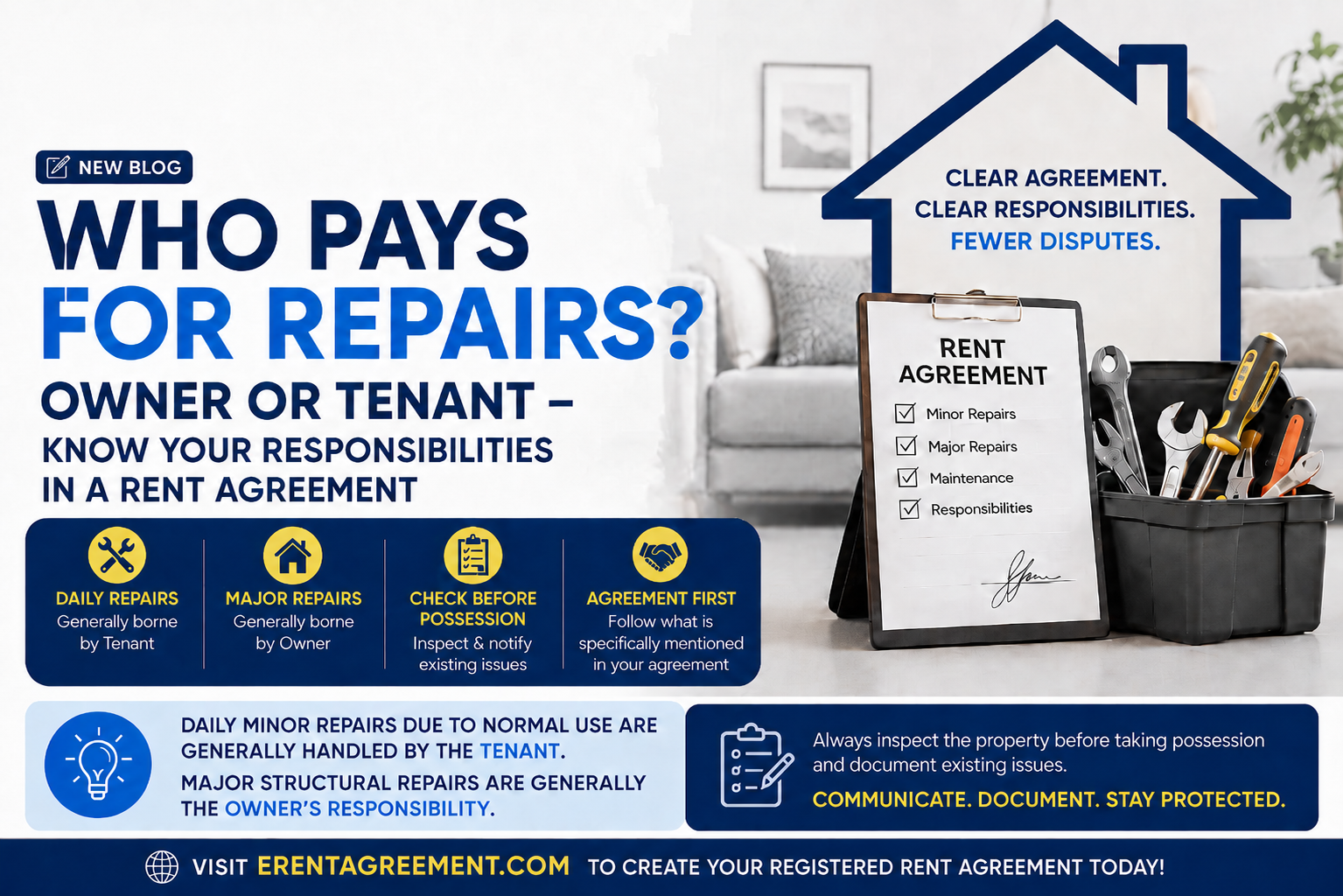
When renting a property, one of the most common disagreements between owners and tenants is: Who should pay when something stops working or needs repair?
Should the tenant pay if a tap starts leaking? What about a damaged switch, clogged bathroom drain, ceiling leakage, burst water pipe, geyser problem or major plumbing issue?
There is no single answer for every situation.
The first thing both parties should check is the Rent Agreement / Leave and License Agreement.
If the agreement clearly mentions who is responsible for a particular repair or category of maintenance, the parties should generally follow the terms mutually agreed in the agreement, subject to applicable law.
However, many agreements simply mention “maintenance” without clearly explaining the difference between daily minor repairs and major structural repairs.
This is where disputes often begin.
At ERENTAGREEMENT, we recommend clearly defining repair responsibilities before the tenant takes possession of the property.
First Rule: Check What Your Rent Agreement Says
Before deciding whether the owner or tenant should pay, read the maintenance and repair clauses in the agreement.
For example, an agreement may state that:
- Day-to-day maintenance will be borne by the tenant
- Structural repairs will be borne by the owner
- Damage caused by the tenant will be repaired at the tenant's cost
- Society maintenance will be paid by the owner
- Minor electrical and plumbing repairs will be paid by the tenant
If your agreement specifically addresses the issue, that clause should be the starting point.
This is why repair responsibilities should be discussed before the agreement is registered, rather than after a problem occurs.
What If Repairs Are Not Clearly Mentioned in the Agreement?
If the agreement does not clearly allocate repair expenses, a practical distinction should generally be made between:
Day-to-Day / Minor Repairs
These are small issues that may arise because the property is being regularly used.
Major / Structural Repairs
These involve the building, concealed systems, structural elements or significant defects that are not ordinarily caused by everyday tenant use.
The cause of the damage is also important.
A repair cannot be classified only on the basis of its cost.
Tenant Should Inspect the Property Before Taking Possession
This is one of the most important steps that tenants frequently overlook.
Before moving into the property, the tenant should carefully check the condition of:
- Lights
- Switches
- Fans
- Plug points
- Taps
- Flush systems
- Wash basins
- Bathroom drainage
- Kitchen sink
- Geyser
- Doors
- Door locks
- Windows
- Cupboards
- Appliances provided with the property
- Water supply
- Existing leakage or seepage
- Flooring
- Walls and ceiling
If something is already damaged or not working, inform the owner before or at the time possession is taken.
Ideally, this should be documented through:
Photographs + Videos + WhatsApp/Email confirmation + Inventory/Condition List
For example:
“Kitchen tap is leaking at the time of possession.”
or:
“One bedroom switchboard is not functioning.”
or:
“There is existing seepage near the bathroom ceiling.”
This creates a clear record that the problem existed before the tenant started occupying the property.
Why Is a Move-In Inspection Important?
Imagine a tenant moves into a flat and after three months says:
“The bathroom tap was already damaged when I moved in.”
The owner may respond:
“It was working perfectly when possession was given.”
Without photographs or written communication, it becomes difficult to determine what actually happened.
A simple move-in inspection can prevent these disputes.
ERENTAGREEMENT recommends creating a property condition record whenever possession is handed over.
Minor Day-to-Day Repairs – Usually Tenant Responsibility
Where the agreement is silent, routine minor repairs arising from ordinary day-to-day usage are commonly expected to be handled by the tenant.
Examples may include:
Light Switch or Electrical Switch Issue
If a switch becomes loose or stops functioning because of normal everyday usage, this can generally be treated as a minor repair.
Tap Leakage
A minor washer replacement, loose tap or small plumbing fitting problem arising during routine use can generally be treated as day-to-day maintenance.
Washroom Drainage Choke
A bathroom or wash basin drain becoming clogged because of:
- Hair
- Soap residue
- Dirt
- Regular usage
would normally be considered a routine maintenance issue.
Kitchen Sink Blockage
If the blockage is caused by food particles, oil or other materials entering the drain during regular use, the tenant would ordinarily be expected to arrange cleaning.
Flush / Small Bathroom Fittings
Minor repair or replacement arising from everyday use may normally fall under tenant maintenance.
Example of Day-to-Day Tenant Repairs
Suppose a tenant has been living in the property for six months.
During that period:
- A light switch stops working
- The bathroom drain gets clogged
- A tap washer needs replacement
- A door handle becomes loose
If these issues developed because of ordinary daily use and there was no pre-existing defect, these would generally be treated as minor day-to-day repairs.
The tenant should normally arrange them unless the agreement states otherwise.
Major Repairs – Generally Owner Responsibility
Major problems involving the property structure or major systems would generally fall on the property owner where they are not caused by tenant misuse.
Examples include:
Ceiling Leakage
If water begins leaking through the ceiling because of:
- Building waterproofing failure
- External seepage
- Plumbing from the upper floor
- Structural problem
this would normally require involvement from the owner and possibly the housing society.
It is not an ordinary daily repair.
Major Water Pipe Burst
If a concealed or main water pipe suddenly bursts because of age, corrosion or infrastructure failure, this is usually a major repair.
The owner should generally arrange or coordinate such work.
Structural Seepage
Persistent seepage through walls or ceilings may require waterproofing or structural work.
This is different from the tenant simply cleaning a blocked bathroom drain.
Major Concealed Plumbing Failure
If pipes located inside the wall or flooring require major repair or replacement, the issue would normally be treated as part of the property infrastructure.
Structural Damage
Problems involving:
- Ceiling
- Main walls
- Structural cracks
- Major waterproofing
- External plumbing
- Major electrical infrastructure
would generally require owner involvement unless the damage was directly caused by the tenant.
Owner Pays for Major Repairs — But Cause Still Matters
It is important not to assume:
“Anything expensive is automatically the owner's responsibility.”
Consider this example.
A tenant drills into a wall without checking and damages a concealed water pipe.
Repairing it may cost a significant amount.
Even though this is a major repair, the damage was caused by the tenant.
Therefore, responsibility may reasonably fall on the tenant.
The correct question is not only:
How expensive is the repair?
It is also:
Why did the problem occur?
Damage Caused by Tenant Is Different From Normal Wear and Tear
Suppose a cupboard hinge naturally becomes loose after several years.
That may be ordinary wear and tear.
Now suppose the cupboard door is physically broken because of misuse.
That is a different situation.
Similarly:
Normal wear
Paint fading gradually.
Tenant-caused damage
Large holes drilled into the wall without permission.
Normal wear
Older bathroom fitting develops a small leak.
Tenant-caused damage
Tap broken due to force or improper handling.
When damage is directly caused by misuse, negligence or unauthorized alteration by the tenant, the repair may be recoverable from the tenant.
What About Appliances Provided With the Property?
Furnished and semi-furnished properties can create additional disputes.
The property may include:
- Air conditioner
- Refrigerator
- Washing machine
- Geyser
- Microwave
- Water purifier
- Fans
- Chimney
The agreement should ideally specify who will pay for:
Routine servicing, minor repairs and major replacement.
For example, the parties might agree:
Tenant will bear routine servicing and minor maintenance. Any major breakdown arising from normal ageing of the appliance will be borne by the owner.
Or the parties may agree to another arrangement.
The important thing is to write it clearly.
What If Something Is Not Working on Day One?
If a tenant discovers a problem before taking possession or immediately after moving in, they should inform the owner immediately.
For example:
“The geyser is not working.”
“Bedroom fan is not operational.”
“Bathroom drain was already clogged.”
“There is existing ceiling seepage.”
If these issues existed before possession, the tenant should not simply repair everything personally and raise the matter months later.
Notify the owner promptly and retain proof.
Create a Property Condition Checklist
One of the easiest ways to avoid disputes is to create a checklist when possession is handed over.
For example:
Item
Condition at Possession
Hall Lights
Working
Bedroom Fan
Working
Kitchen Tap
Slight leakage
Bathroom Drain
Working
Geyser
Working
AC
Working
Main Door Lock
Working
Wall near Bathroom
Existing seepage
Refrigerator
Working
Washing Machine
Working
Both parties can keep the record.
Photographs can also be attached or exchanged digitally.
Tenant Should Report Major Problems Immediately
Tenants should not ignore a major problem because they believe the owner is responsible.
For example, if a concealed pipe begins leaking and the tenant ignores it for several weeks, the resulting damage may become much larger.
The tenant should:
Inform the owner immediately → Share photographs/video → Prevent additional damage where reasonably possible → Allow access for repairs
Prompt communication protects both parties.
Owner Should Not Delay Serious Property Repairs
Similarly, once an owner is informed about a genuine major problem, unnecessary delay can make the damage worse.
For example:
A small ceiling leakage can eventually damage:
- Paint
- Electrical wiring
- Furniture
- Flooring
- Neighbouring property
Major repair issues should therefore be handled promptly.
Who Pays Society Maintenance?
Society maintenance is separate from minor repairs.
The Rent Agreement should clearly specify whether maintenance is payable by:
Owner or Tenant
There is no reason for both parties to assume different arrangements.
Similarly, special society repair contributions, sinking fund-related issues or major building repair charges should be separately understood rather than simply calling everything “maintenance.”
Can Repair Cost Be Deducted From the Security Deposit?
Security deposit deductions can become another source of dispute.
At the time the tenant vacates, legitimate deductions may depend on:
- Agreement terms
- Unpaid rent
- Outstanding utilities
- Tenant-caused damage
- Missing fixtures
- Other mutually agreed liabilities
However, ordinary ageing or normal wear and tear should not automatically be treated as tenant-caused damage.
Both parties should compare the property condition at move-in and move-out.
This is another reason why photographs taken at possession are extremely useful.
A Better Repair Clause for Rent Agreements
Rather than writing only:
“Repairs shall be borne by the tenant.”
the agreement can be much clearer.
For example:
The Licensee shall be responsible for routine day-to-day minor repairs arising from ordinary use of the premises, including minor electrical switches, taps, drainage cleaning and similar consumable or usage-related maintenance. Major structural repairs, concealed pipeline failures, building seepage, waterproofing issues and other significant repairs not caused by the Licensee's negligence or misuse shall be the responsibility of the Licensor. Any damage caused by negligence, misuse or unauthorized alteration by the Licensee shall be repaired at the Licensee's cost.
The final wording should always reflect what both parties actually agree to.
Quick Guide: Owner or Tenant?
Repair / Issue
Generally Who Handles It?*
Light switch stops working due to regular use
Tenant
Loose tap / washer replacement
Tenant
Bathroom drain clogged due to hair/soap
Tenant
Kitchen sink blocked due to usage
Tenant
Loose door handle
Tenant
Ceiling leakage / structural seepage
Owner
Concealed water pipe burst
Owner
Major waterproofing problem
Owner
Structural wall issue
Owner
Old major plumbing infrastructure failure
Owner
Damage caused directly by tenant
Tenant
Existing defect identified at possession
Owner / as mutually agreed
*This is a general practical guide. The Rent Agreement terms, actual cause of damage and applicable law should always be considered.
Frequently Asked Questions
Who pays for a leaking tap in a rented house?
If it is a minor repair arising from daily use, it would generally be treated as routine tenant maintenance unless the agreement says otherwise. If the problem existed before possession, the tenant should notify the owner.
Who pays when the bathroom drainage is clogged?
If the drain is clogged due to normal occupant usage, hair, soap residue or similar causes, cleaning would ordinarily be a tenant responsibility.
If the problem results from a major building drainage defect, responsibility may lie elsewhere.
Who pays for ceiling leakage?
A ceiling leakage caused by building structure, waterproofing or concealed plumbing would generally require owner/society involvement unless the tenant directly caused the damage.
Who pays for a burst water pipe?
If a concealed/main pipe bursts because of ageing or infrastructure failure, this would normally be treated as a major repair and handled by the owner.
If the tenant damaged the pipe, responsibility may shift to the tenant.
What if the agreement clearly says the tenant will pay for repairs?
The exact wording of the agreement should be reviewed. Clearly agreed contractual terms are important, subject to applicable law and the circumstances of the damage.
Should tenants inspect the flat before possession?
Yes.
Both parties should inspect the property and document any existing defects before possession is handed over.
Avoid Repair Disputes Before They Start
The best time to discuss repairs is before signing the Rent Agreement, not after a tap starts leaking or the ceiling begins dripping.
A well-drafted agreement should clearly differentiate between:
Minor Day-to-Day Repairs → Tenant
Major Structural / Property Repairs → Owner
Damage Caused by Tenant → Tenant
Pre-Existing Issues → Identify Before Possession
At ERENTAGREEMENT, customers can customize mutually agreed clauses while preparing their Registered Rent Agreement so that responsibilities are clear from the beginning.
👉 Visit erentagreement.com to calculate your fees and start your Registered Rent Agreement.
Clear Agreement. Clear Responsibilities. Fewer Disputes.
Title:
Who Pays for Repairs in a Rent Agreement? Owner vs Tenant Responsibilities
Description:
Who pays for repairs in a rented property? Learn whether the owner or tenant should pay for taps, switches, clogged drains, ceiling leakage, pipe bursts, structural repairs and daily maintenance.
Primary Keyword:
Who Pays for Repairs Owner or Tenant
Secondary Keywords:
Rent Agreement Repair Responsibility
Owner Tenant Repair Responsibility
Who Pays Maintenance in Rental Property
Minor Repairs Tenant Responsibility
Major Repairs Landlord Responsibility
Tenant Maintenance Responsibilities India
Owner Repair Responsibilities Rent Agreement
Rent Agreement Repair Clause
Ceiling Leakage Owner or Tenant
Plumbing Repair Owner or Tenant

 +91-7378861163
  info@erentagreement.com
  8:00AM - 9:00PM